Historic First: Recording a Dying Human Brain Reveals Surprising Activity
Scientists worldwide, including experts at the University of Louisville, are stunned by the groundbreaking first-ever EEG recording of a human brain during death. This rare event unfolded in Vancouver, Canada, where an 87-year-old epilepsy patient, under continuous brain wave monitoring, suffered a fatal heart attack. What started as seizure detection turned into a window into the final moments of life, challenging long-held mysteries about what happens when the heart stops.
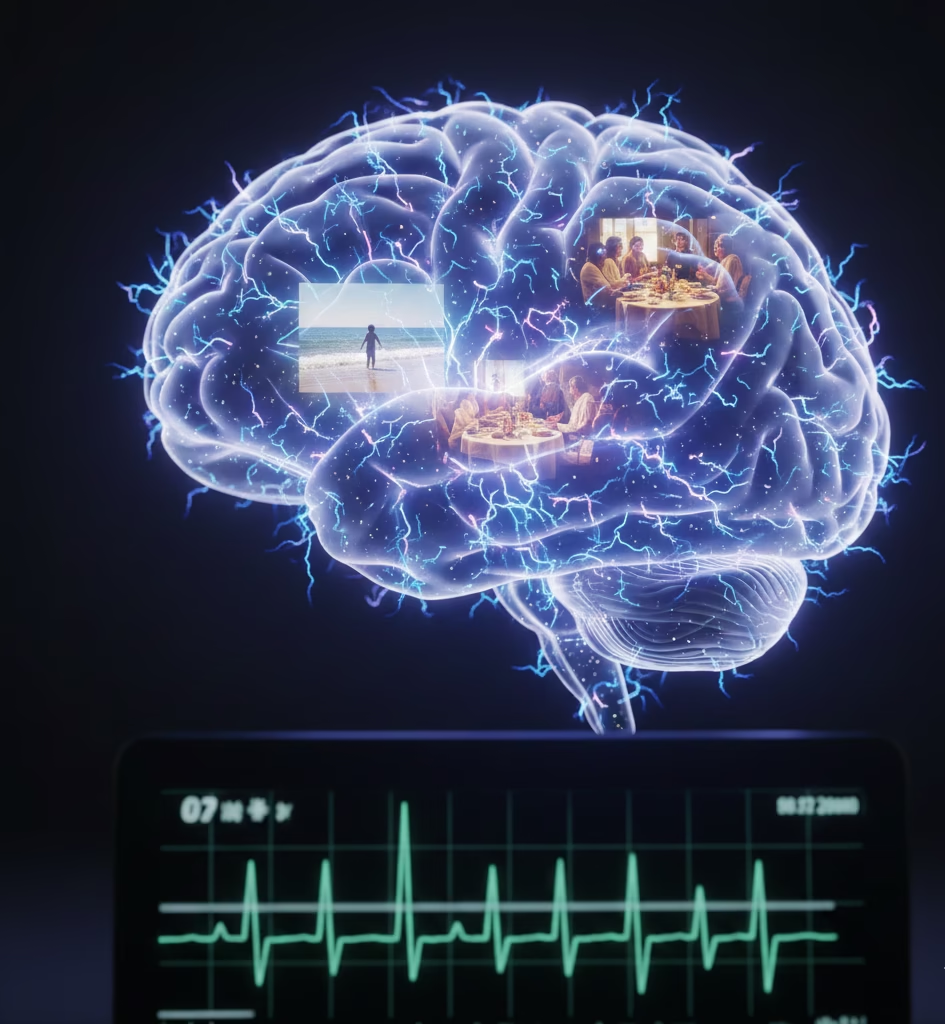
The study‘s lead organizer, University of Louisville neurosurgeon Dr. Ajmal Zemmar, analyzed 900 seconds of brain activity, zeroing in on the 30 seconds before and after cardiac arrest. Published in Frontiers in Aging Neuroscience under the title “Enhanced Interplay of Neuronal Coherence and Coupling in the Dying Human Brain,” the research uncovers bursts of synchronized neural activity—gamma oscillations linked to memory recall, dreaming, and focus. These spikes resemble “life flashing before your eyes,” a phenomenon echoed in near-death experiences (NDEs).
The Vancouver Patient: A Serendipitous Discovery
The patient, an 87-year-old man, fell and was admitted for epilepsy monitoring. Researchers from the University of Tartu, led by Dr. Raul Vicente, used electroencephalography (EEG) to track seizures. Unbeknownst to them, the session captured his sudden heart attack and death.
-
EEG Timeline Insights:
Time Point Brain Activity Observed 7 hours before death (Panel A) Baseline waves, stable but unremarkable. Approaching cardiac arrest (Panels B-C) Rising gamma, delta, theta, alpha, and beta oscillations. Post-heart stop (Panel D, 30 seconds after) Peak synchronization, suggesting coordinated “life recall.”
Images from the study show vivid brain scans transitioning from routine monitoring to intense, flashback-like surges. Courtesy: Frontiers in Aging Neuroscience. This isn’t random noise—it’s structured activity, hinting the brain actively orchestrates its shutdown.
Dr. Zemmar explains: “Just before and after the heart stopped, we observed enhanced gamma oscillations, alongside delta, theta, alpha, and beta waves. These are tied to concentration, meditation, and memory processing.” Such patterns align with NDE reports of vivid life reviews, suggesting the dying brain replays key memories as a final act.
What Happens in the Brain at Death? Key Revelations
For centuries, neuroscientists have debated post-cardiac arrest brain function. Traditional views held that brain activity flatlines immediately after the heart stops, defining clinical death. This study flips that script.
The brain didn’t fade quietly. Instead:
-
Gamma Oscillations Surge: Fast waves (30-100 Hz) associated with high-level cognition spiked dramatically.
-
Multi-Band Synchronization: Delta (slow, deep sleep-like), theta (dreaming), alpha (relaxed awareness), and beta (active thinking) waves coupled intensely.
-
Potential “Life Recall”: Evidence points to a programmed recall of life events, mirroring NDE anecdotes where people relive memories in seconds.
This “enhanced interplay of neuronal coherence” implies the brain remains viable and purposeful even as oxygen depletes. Zemmar notes it could explain why some cardiac arrest survivors report profound visions—perhaps a universal dying process.
Broader Implications for Neuroscience
These findings redefine brain death criteria. Does the heart stopping equal total shutdown if neural networks persist? EEG alongside EKG could refine protocols, impacting:
-
Organ donation timing: Harvesting too soon might interrupt viable brain function.
-
Legal death declarations: When exactly does consciousness end?
-
Consciousness studies: Links to dreaming, psychedelics, and altered states.
Redefining Death: Scientific, Ethical, and Philosophical Questions
Dr. Zemmar raises provocative queries: “When do we declare death? The heart stops, but the brain keeps going. Should EEG be mandatory?” This could spark global debates on:
-
Medical Protocols: Integrating brain wave monitoring for precise end-of-life care.
-
Organ Harvesting: Delaying until EEG confirms neural silence to respect potential awareness.
-
Philosophical Angles: Does this validate spiritual ideas of a soul’s final journey or afterlife glimpses?
On a metaphysical note, Zemmar finds the discovery “calming.” He envisions comforting families: “Their loved one’s brain may be reliving cherished moments—a warm farewell amid the end.”
Global Resonance
The study has drawn international acclaim, resonating personally. “We’ve all lost someone,” Zemmar reflects.”This provides answers about their last moments, helping to soothe the sorrow of families now and for generations to follow.”
Why This Matters for Near-Death Experiences and Future Research
Near-death experiences (NDEs) affect up to 20% of cardiac arrest survivors, per studies like the AWARE project. Common themes—tunnels of light, life reviews—now gain neurobiological backing. This single case, though limited (no control group), sets a precedent for intentional studies on dying brains.
Future Directions:
-
Larger cohorts with advanced EEG and fMRI.
-
Animal models to test hypoxia-induced oscillations.
-
AI analysis of brain waves for predictive death signatures.
For patients facing terminal illness, it offers solace: Death isn’t chaos but a symphony of recollection. As Zemmar puts it, “The brain may play a last recall of important life events, fostering warmth in farewell.”
This breakthrough from Vancouver to Louisville invites us to rethink mortality—not as void, but vivid.
liked this article? visit BB