The Art of Letting Go: How Jon Foreman Creates Ephemeral Masterpieces on the Welsh Coast
Along the windswept shores of Pembrokeshire in southwestern Wales, land artist Jon Foreman kneels across the damp sand, sorting beach stones by shade and dimension. Starting at the center with miniature pebbles, he spirals outward using progressively larger stones. A subtle gradation from pale tones to deep, dark hues tricks the eye, producing a striking illusion of three-dimensional depth across an entirely flat tidal plane.
Within hours, the Atlantic tide will sweep across the sandbar, flattening the stones and dismantling hours of meticulous geometry. For Foreman, that sudden erasure is not a tragedy—it is the ultimate fulfillment of the work. If conditions align, he remains standing on the shoreline simply to watch the waves swallow his creation whole.
In a conversation with The Great Planet, Foreman reflected on his craft, the philosophy of impermanence, and the liberating practice of producing work that is never destined to survive.
Key Highlights
- Childhood Terrain as Canvas: Based in Pembrokeshire, Foreman has developed site-specific coastal and woodland installations since 2011.
- Scale and Diversity: Works range from intimate leaf arrangements sorted by autumnal hue around tree trunks to sprawling sand drawings measuring up to 100 meters wide.
- The Parkour Influence: Early training in parkour reshaped how Foreman perceives urban and natural geometry, treating ordinary environments as dynamic spaces of interaction.
- The Living Artwork: Foreman considers a piece finished when the last stone is set, but views its true lifespan as continuing until natural forces completely dissolve it.
- A Philosophy of Detachment: Years of crafting temporary installations have reshaped his view of daily life, advocating that modern society needs to reduce its attachment to permanence.
From Urban Movement to Coastal Geometry
Foreman’s distinctive way of interpreting physical space began well before his formal training in art school. As a youth practicing parkour, he learned to read ordinary urban landscapes through movement and structure. Handrails, concrete walls, and staircases ceased to be static background objects; instead, they became interactive geometries that demanded engagement and adaptation.
When Foreman later encountered the land art tradition during his academic studies, he translated that kinetic awareness directly into natural settings. Rather than imposing artificial monuments onto the wilderness, he began orchestrating the natural matter already resting underfoot.
Since 2011, his regional home of Pembrokeshire has served as his primary studio. His works span two distinct environments:
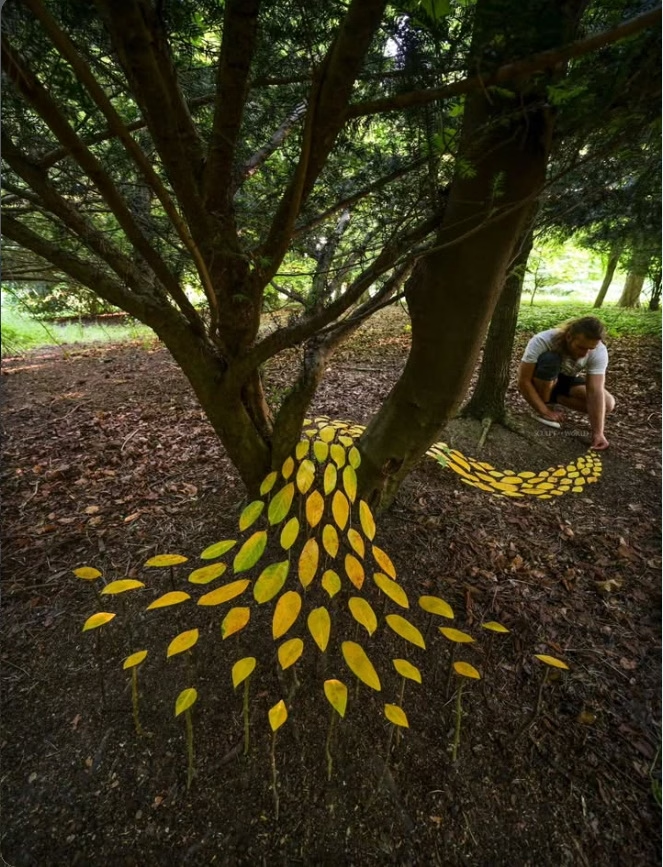
- Woodland Interventions: Meticulously graded autumn leaves gathered and clustered by color around the bases of tree trunks, contrasting vibrant organic pigmentation against rough bark.
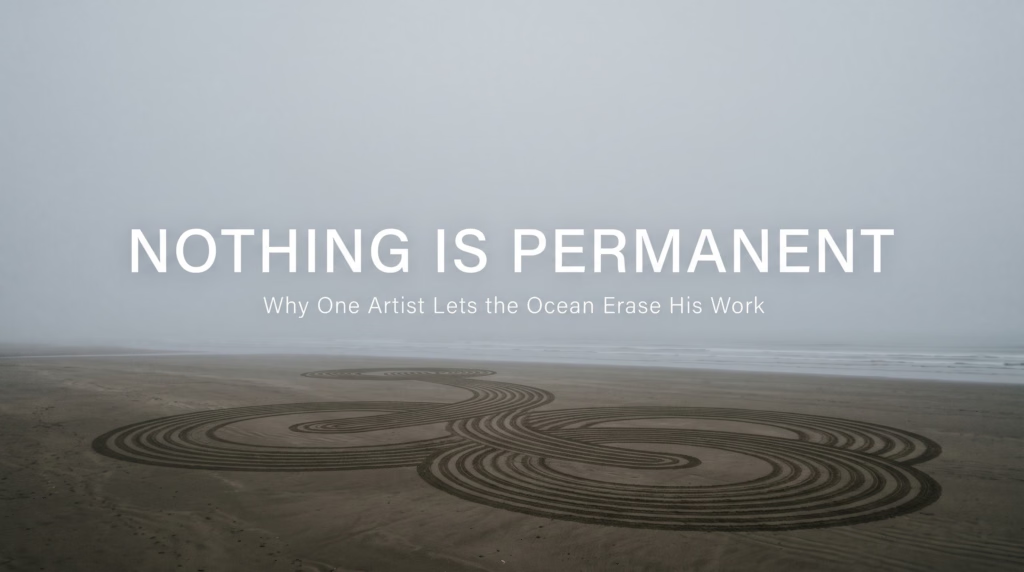
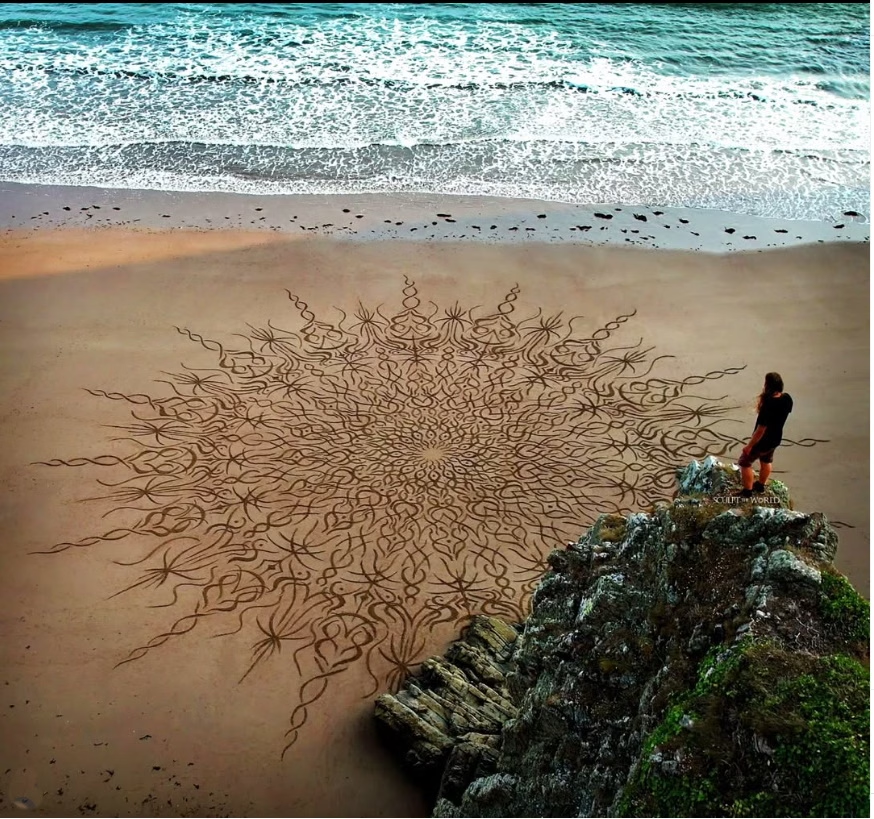
- Tidal Sand Etchings: Grand geometric drawings scored across wide stretches of open beach, occasionally expanding up to 100 meters in diameter, visible only from elevated coastal cliffs before the incoming tide washes the sand smooth again.
Collaborating with the Unpredictable: Nature as Co-Creator
Working with raw elements outdoors requires relinquishing total artistic control. For Foreman, shifting weather conditions are not disruptions to be avoided, but active participants in the creative dialogue. Gusts of wind can sweep away hours of carefully placed foliage, while driving rain and swelling tides frequently alter the contours of an unfinished design.
Such volatility forces the artist to remain adaptable. When weather conditions shift mid-process, Foreman often abandons his preconceived blueprints, allowing the environment to dictate the final form.
“My work is done when I place the last leaf or stone or stick, but the piece lives until nature is finished with it. If I’m lucky, I see it washed away before I leave.” — Jon Foreman, speaking to The Great Planet
This perspective redefines traditional ideas of artistic completion. The human intervention marks only the opening chapter of the artwork; the subsequent dissolution carried out by wind, surf, or rain constitutes its living continuation.
Challenging the Modern Obsession with Permanence
Living in a culture centered around ownership, preservation, and permanent collection, Foreman’s practice presents a quiet counter-narrative. Repeatedly watching his labor vanish has reshaped his personal philosophy well beyond the shoreline.
“It’s enhanced my view of the world entirely. Permanence is something we need to reduce. We become too attached to things.”
By creating pieces with a predetermined lifespan measured in hours rather than centuries, Foreman critiques the reflex to hold onto objects indefinitely. The transient nature of the work serves as an invitation to appreciate experiences in their immediate moment, free from the anxiety of maintaining them forever.
The Paradox of the Photographic Artifact
The roots of Foreman’s approach trace directly back to the land art movement that emerged during the late 1960s. That generation of artists sought to break away from portable gallery commodities, choosing instead to work directly within the terrain. Because these interventions were often situated in remote or temporary environments, photography quickly became an essential bridge to connect the work with a broader public.
Today, the vast majority of audiences encounter Foreman’s installations through high-resolution photography. This creates a fascinating tension:
- The Digital Archive: The photograph remains sharp, static, and perpetually accessible across screens and print media.
- The Physical Reality: The physical formation of stones or leaves depicted in the image has long since scattered, dissolved by the wind or swept away by the sea.
While photography preserves the memory of the design, Foreman cautions against confusing the document with the essence of the work itself.
Process Over Dogma: Leaving Meaning to the Observer
Foreman avoids prescribing rigid philosophical meanings for his audience. While critics frequently interpret his work as an allegory for human mortality or environmental change, Foreman leaves the interpretation entirely open to the viewer.
Focusing exclusively on the theme of impermanence risks overlooking what fundamentally draws the artist to his practice:
- The Tactile Immersion: The physical act of gathering, sorting, and positioning cold stones or crisp leaves.
- The Outdoor Engagement: Spending quiet, dedicated hours immersed in coastal weather and changing light.
- The Emerging Structure: The visual satisfaction of seeing intricate geometric patterns rise out of raw, scattered wilderness.
When the work is complete and the tide eventually disperses the composition, Foreman leaves every stone exactly where he found it. By returning the raw materials unaltered to the shore, he keeps the creative cycle open—leaving those same pebbles to one day become part of another artwork in someone else’s hands.
for more interesting facts visit BB