The Invisible Infrastructure: A Comprehensive Guide to Data Centres in the AI Era
Every digital service, video stream, cloud file, UPI payment, and artificial intelligence answer relies on a physical home known as a data centre. These secure facilities are packed with networking equipment, storage systems, and servers that form the foundation of our modern digital existence. While artificial intelligence is often conceptualized as living in the cloud, the reality is that the cloud physically resides in data centres. These specialized facilities operate at the critical intersection of science, economy, and the environment, defining the infrastructural limits of our modern technological capabilities.
Defining the Data Centre: The Backbone of the Digital Economy
A data centre is far more than just a room filled with computers; it is a continuously operating, 24×7 high-reliability infrastructure system. It functions as a physical facility explicitly designed to move, process, and store digital information. By keeping digital records, cloud services, apps, payments, and websites running continuously, it serves as the literal physical backbone of the global digital economy.
To achieve this constant uptime, data centres rely on a sophisticated array of integrated components:
-
Servers: These specialized machines are tasked with performing all primary computing tasks.
-
Storage Systems: These systems are engineered to hold vast amounts of digital data.
-
Networking Equipment: This hardware is responsible for moving data across networks at remarkably high speeds.
-
Power Backup: Uninterruptible Power Supply (UPS) units, large batteries, and generators are installed to keep systems alive during grid failures.
-
Cooling Systems: These are essential mechanisms designed to remove the massive amounts of heat generated by computing machines.
-
Security & Monitoring: These protocols and systems are in place to ensure maximum uptime and protect sensitive data.

The Artificial Intelligence Catalyst
The unprecedented rise in artificial intelligence adoption has triggered a corresponding boom in data centre development. Higher AI adoption directly translates to a heightened demand for electricity, cooling, and new data centres.
Historically, traditional cloud usage—such as streaming content, running applications, hosting websites, and storing files—represented lighter workloads that required lower compute power. Artificial intelligence, however, requires substantially more computing power than standard document storage or web browsing. AI workloads are characterized by heavy processing requirements, where large models must be trained on enormous datasets and run continuously to answer user queries. These advanced AI operations involve running GPUs at scale, processing billions of simultaneous calculations, and serving millions of global queries. The architecture of an AI request flows sequentially from a user prompt, to the AI model, through a GPU cluster, utilizing storage and networking, before finally delivering a response.
India’s Digital Infrastructure Boom
India is experiencing a massive data-centre boom driven by soaring digital demand. The country is rapidly transitioning from simply being a massive consumer of data to establishing itself as a major host of digital infrastructure. This rapid rise in installed data-centre capacity is fueled by the expansion of AI adoption, streaming services, e-commerce, digital payments, and cloud services.
Statistically, India’s installed capacity is projected to undergo more than a 4x growth rate. The capacity stood at approximately 375 MW in 2020 and is projected to reach approximately 1,575 MW by 2026.
This infrastructure is clustering in strategic locations based on specific geographic and systemic requirements:
-
Site Preferences: Data centres strongly prefer locations that offer policy support, land availability, reliable electricity, and strong connectivity.
-
Major Hubs: The primary established locations include Delhi-NCR, Bengaluru, Hyderabad, Chennai, and Mumbai-Navi Mumbai.
-
Emerging Locations: States gaining traction as new infrastructure hubs include West Bengal, Chhattisgarh, Madhya Pradesh, and Andhra Pradesh.
Strategic and Economic Imperatives
For India, data centres represent both a strategic infrastructure layer and a crucial economic asset. In the modern digital age, these facilities are becoming just as vital to national development as power plants, highways, and seaports. They are not merely buildings; they improve India’s capacity in the AI and cloud era, strengthen domestic infrastructure, and support essential digital services.
India’s push for more data centres is rooted in five strategic pillars:
-
Lower Latency: Localizing infrastructure ensures faster access to AI services, applications, and the cloud.
-
Digital Economy Support: A robust data centre network strengthens digital public infrastructure, e-governance, OTT platforms, e-commerce, and fintech.
-
Investment Inflow: Building these facilities successfully attracts both foreign and domestic capital.
-
AI Readiness: Establishing these centres provides the necessary computing backbone for the next wave of technological innovation.
-
Strategic Capability: Expanding domestic capacity builds greater control over critical national digital infrastructure.
The Hidden Environmental Costs: Electricity and Cooling
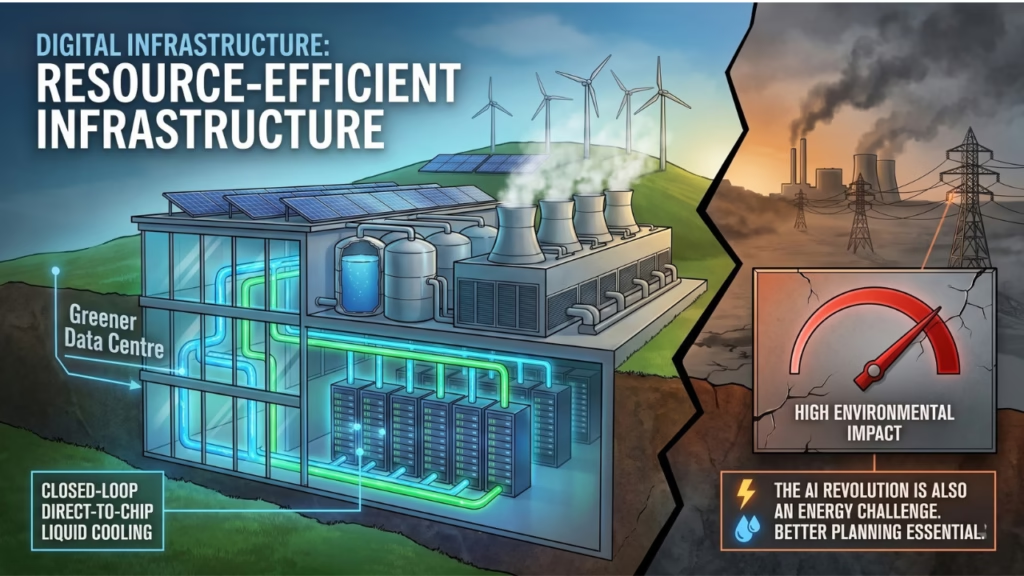
The AI revolution brings a significant energy challenge. Because AI infrastructure runs continuously on large amounts of power, data centres must operate on a 24×7 basis. Within these facilities, backup systems must remain on standby, cooling systems never sleep, and servers run continuously. Consequently, computing consumes electricity relentlessly, and cooling those computers requires major additional energy inputs.
Grid reliability is absolutely crucial, as backup systems further add to overall infrastructure needs. By the financial year 2031-32, the projected electricity demand specifically from India’s data centres is expected to reach 13.56 GW. If data centre capacity scales faster than the supply of clean power, it can significantly increase emissions and place intense pressure on the power grid. Therefore, smart grid planning, renewable power integration, and better energy efficiency are essential.
Beyond electricity, digital infrastructure must answer complex environmental questions regarding water and cooling. Every single unit of computing generates heat because servers convert electricity directly into computing processes, and almost all of that consumed energy eventually becomes heat. If this heat is not promptly removed, the machines will fail.
The cycle is absolute: more computing leads to more heat, which in turn demands more cooling. Traditional cooling methods can use significant amounts of water, making local water stress a vital factor in choosing a data centre location. Because cooling is heavily energy-intensive, efficient facility design is vital to reduce the overall environmental impact. While a data centre might look clean from the outside, its actual environmental footprint depends heavily on its water management practices, cooling design, and electricity mix. To create greener infrastructure, the industry is exploring solutions such as immersion cooling, adiabatic cooling, closed-loop systems, and direct-to-chip liquid cooling.
Economic Realities: Investments vs. Job Creation
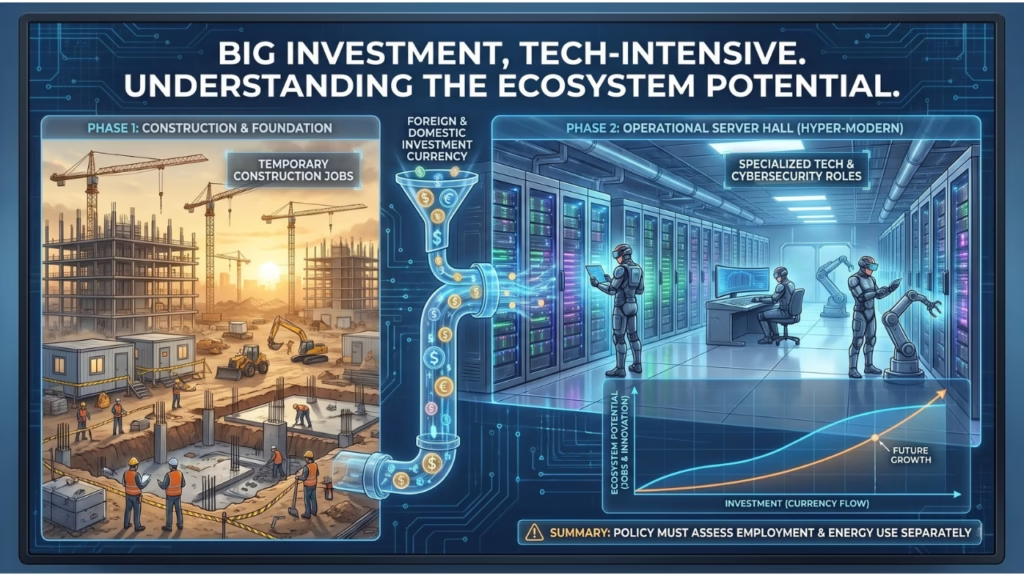
Data centres generate immense economic value, but they present a unique paradox regarding employment: their job intensity is considerably lower than many traditional manufacturing sectors. While they attract large capital investments, they do not create direct jobs in the same labor-intensive manner as traditional factories. They are inherently technology-intensive and capital-intensive operations.
Employment breaks down across distinct phases:
-
Construction Phase: This phase creates temporary jobs in logistics, installation, electrical systems, and civil works.
-
Operations Phase: The daily running of a facility requires specialized roles in monitoring, facilities management, cooling, cybersecurity, maintenance, and networking.
-
Wider Ecosystem: Broader economic activity is generated indirectly through power systems, equipment manufacturing, fibre optics, telecom, AI startups, and cloud services.
Because high investment does not directly equate to high direct employment, policymakers must independently assess local employment, energy use, and capital investment. However, the broader expected ecosystem potential could support around 1 lakh engineering jobs.
Sovereignty, Security, and Data Localisation
In the modern digital age, data infrastructure is heavily intertwined with issues of sovereignty and governance. The physical location of stored data matters significantly, transforming data centres from a purely economic issue into matters of strategic autonomy, jurisdiction, regulation, and privacy.
The critical policy question has shifted from simply demanding “more data centres” to asking what specific data should be stored locally and under what specific rules. Data localisation offers distinct benefits and challenges:
-
Lower Latency: Storing data locally can make digital services notably faster for domestic users.
-
Regulatory Control: Domestic storage makes compliance with local domestic laws significantly easier.
-
Data Security: Highly sensitive national or personal data may require the stronger safeguards that local servers provide.
-
Strategic Autonomy: Localizing data centres creates less dependence on external, foreign digital infrastructure.
-
Cost & Complexity: Conversely, strict localisation mandates can increase overall infrastructure and compliance costs.
The fundamental takeaway for nations building this infrastructure is the necessity to build smart, not just big. Data centres highlight how sustainability, development, and technology have become deeply interconnected. The digital economy is far from weightless; behind every byte of artificial intelligence lies a very physical demand for governance, capital, water, electricity, and land. A truly smart data-centre ecosystem must be environmentally responsible, energy-aware, and economically useful. This requires a comprehensive checklist prioritizing high-skill ecosystem development, balanced data governance, strong cybersecurity and connectivity, efficient water reuse and cooling, low-carbon or renewable power, and ultimately, reliable electricity. By viewing digital infrastructure through the combined lenses of energy, environment, economy, and science, we can build a resilient foundation for the AI-driven future.
for more articles visit BB