Ancient Underground City Discovered Under Giza: A Two-Kilometer Megastructure Shocks Archaeologists
In one of the most astonishing archaeological revelations of the decade, researchers claim to have uncovered what could be an enormous underground city beneath Egypt’s Giza Plateau. The find, reportedly stretching over two kilometers beneath the desert surface, could completely alter modern understanding of ancient Egyptian history and human civilization’s origins.
This discovery, highlighted in a detailed 2025 report by Timeless Tales HQ, suggests that the subterranean site contains vast chambers, spiral shafts, and intricate passage networks. These underground formations, mapped through advanced satellite imaging and Synthetic Aperture Radar (SAR) tomography, appear too deliberate and symmetrical to be naturally formed. If verified, this could indicate a previously unknown chapter of pre-dynastic architecture—possibly dating thousands of years before Egypt’s Pharaohs erected the iconic pyramids.
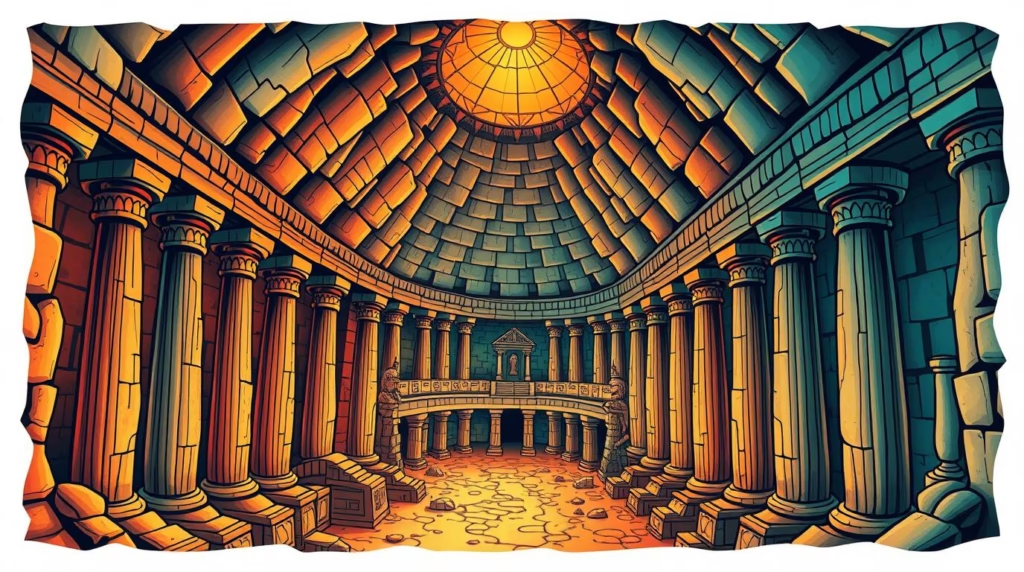

Satellite Imaging Reveals a Subterranean Megastructure
The alleged megastructure was brought to light through SAR and ground-penetrating radar systems operated by collaborative teams of Scottish and Italian scientists. Using Synthetic Aperture Radar—a military-grade technology that sees through sand, stone, and sediment—the teams generated 3D subsurface scans around and beneath the Giza Plateau.
According to the digital tomography results, beneath the foundations of the Sphinx and the Great Pyramid lies a grid-like formation resembling a honeycomb. The structure reportedly extends horizontally for about 2.2 kilometers, comprising massive rooms, vaulted corridors, and spiral wells plunging almost 650 meters deep. Each chamber is geometrically aligned and proportioned with engineering precision that modern architects find astonishing.
These images supposedly reveal corridors leading toward the Nile River basin. The consistency of the geometric alignment suggests artificial creation. Preliminary data also indicates magnetically distinct materials in deeper layers, implying potential use of unknown construction compositions or technologies.
Could This Redefine Ancient Egyptian History?
If authenticated, the implications are profound. Official Egyptology attributes large-scale construction in the Giza Plateau to the Old Kingdom period, roughly between 2,600–2,400 BCE. Traditional scholars maintain that no advanced civilizations preceded dynastic Egypt in the region.
However, these radar readings could signify something much older. Some scientists suggest the underground complex may predate known Egyptian civilization by several millennia—possibly to a forgotten age when early cultures experimented with subterranean architecture.
Independent researchers and alternative historians have long speculated about Giza’s “undisclosed chambers.” The newly released SAR imagery reignites those theories, drawing parallels to the supposed “Hall of Records” described in classical legends and esoteric texts.
Giza’s Hidden Network: A Subterranean Metropolis?
The Timeless Tales HQ report describes the structure as a “honeycomb-shaped labyrinth,” containing interconnected passageways, circular galleries, and chambers up to 80 meters wide. Some pathways reportedly descend in a spiral fashion reminiscent of modern architectural ramps or hydraulic tunnels.
Dr. Corrado Malanga, an Italian researcher associated with the project, claims that the regularity in the angular measurements cannot be explained by natural geology. Preliminary 3D imaging models show right-angled corridors, polygonal rooms, and reinforced ceilings that appear intentionally supported.
Interestingly, several vertical shafts link the upper plateau to deeper sections, suggesting the entire design might have served as a complex hydraulic or ventilation system. Researchers speculate that ancient engineers might have built it to regulate underground water flow or preserve subterranean spaces from erosion.
Possible Connection to the Osiris Shaft
While the concept of hidden catacombs beneath Giza is not new, the new evidence appears to tie into one already-known structure—the Osiris Shaft. This multi-level subterranean chamber, located near the causeway of Khafre’s Pyramid, has intrigued archaeologists for decades. It features a 35-meter vertical drop leading to chambers containing sarcophagi and water-filled basins.
New radar scans suggest that the Osiris Shaft could be a visible entrance to a much more extensive hydraulic tunnel system. Inside the shaft, archaeologists recorded granite structures surrounded by an artificial water channel connecting to deeper aquifers.
If the radar models are accurate, these aquifers may flow through narrow tunnels leading toward the newly discovered spaces. The pattern of water erosion observed in sediment samples further supports this connection. Some mineral deposits align with Nile flood layers predating 3,100 BCE, hinting that part of the system may have existed even before Egypt’s First Dynasty.
Advanced Hydraulic Design from a Lost Era?
One of the most puzzling aspects of the Giza megastructure is its apparent hydraulic sophistication. No known civilization during ancient Egypt’s early timeline had the engineering means to create pressure-regulated water networks. Yet, according to experts analyzing the radar data, the underground system seems meticulously designed to control and redirect ground water through valves, tunnels, and channels.
The engineers of that era, whoever they were, might have harnessed natural hydropressure to stabilize the subterranean environment. The intricate coupling between chambers and aquifers points to an intentional design—perhaps even serving ritual or preservation functions.
Hydrologists observing the findings note similarities to ancient subterranean systems found in Turkey’s Derinkuyu and Cappadocia regions, and to water temples in India and Iran. These comparisons raise the provocative possibility that early human civilizations shared common engineering concepts long before organized dynasties emerged.
Egypt’s Official Response and Controversy
Despite the growing intrigue, Egyptian authorities have strongly rejected the claims. The Ministry of Tourism and Antiquities has stated that no credible excavation permits have been granted for the area, and all archaeological sites around the Giza Plateau are monitored. Former Antiquities Minister Zahi Hawass, known for his defense of conventional Egyptian chronology, publicly dismissed the radar results as “unscientific fiction.”
According to several anonymous workers cited in the original report, initial tunneling attempts in the 1960s allegedly exposed sealed passageways containing unusual carvings. Within a day, officials are said to have re-sealed the area. While no verifiable documentation supports this account, the secrecy surrounding Giza’s subterranean features continues to fuel speculation.
Egyptian cultural heritage advocates argue that unverified investigations and speculative media coverage risk damaging both the integrity of the monuments and Egypt’s tourism image. However, independent researchers counter that the refusal to allow further scanning invites doubt. The ban on new research, they suggest, makes it impossible to verify or disprove the claims entirely.
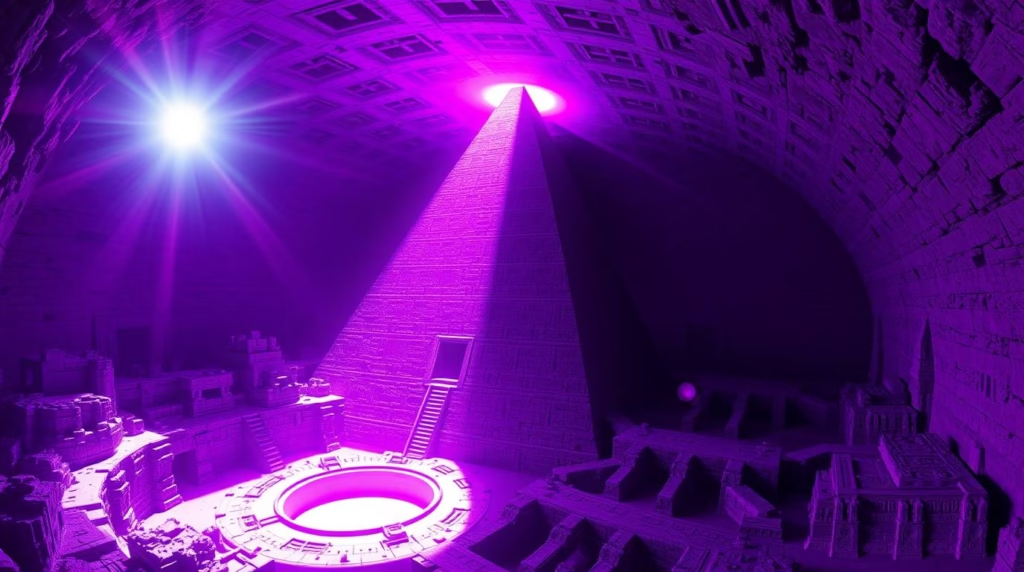
Critics Call It Pseudoscience
Mainstream Egyptologists and geologists remain skeptical of the alleged discovery. Critics point out that ground-penetrating radar often produces ambiguous readings, especially in areas containing mixed sandstone, limestone, and cavities created by natural erosion. They argue that interpreted “chambers” might simply be geological anomalies or faults misread as artificial structures.
Dr. Corrado Malanga’s involvement has fueled the controversy further. While his earlier works in theoretical physics and consciousness studies gained niche attention, academics accuse him of crossing over into pseudoscience. His detractors argue that publishing sensational claims without field verification undermines serious archaeology.
Nevertheless, proponents insist that radar tomography has previously identified hidden chambers with accuracy—in both historical and conflict-zone explorations. They cite examples from Syria, Turkey, and Central America, where SAR imaging led to eventual excavation confirmation. The technology’s success elsewhere, they argue, supports the validity of conducting controlled field testing beneath Giza too.
The Mystery of Giza’s Forbidden Zones
Rumors about hidden zones under Giza have circulated for decades. Several explorers, including media crews, have reported restricted tunnels leading beneath the Sphinx and Pyramid plateau. Local guides have claimed sealed doorways and vertical shafts inaccessible to the public.
Official Egyptian statements, however, maintain that these closed passages either end abruptly or contain nothing significant. Still, international independent researchers point to inconsistencies in public site maps and excavation archives.
If the newly scanned megastructure exists, it could be connected to these restricted areas. Some theorists even suggest that the original builders might have constructed the pyramids on top of existing ruins—transforming older, sacred geological sites into symbolic monuments of dynastic power.
Could a Lost Civilization Have Built It?
For many alternative scholars, the discovery reinforces the long-debated idea that Egypt was the inheritor, not the origin, of an older civilization’s knowledge. This notion aligns with ancient Egyptian texts describing Zep Tepi—“the First Time,” a mythical epoch when gods walked among humans and created sacred sites before recorded history.
The precision and megascale architectural planning hinted at in the radar data might lend credence to such myths. If proven, it would challenge linear historical models, pushing back the timeline of organized construction and scientific understanding by several thousand years.
Some anthropologists warn, however, that attributing advanced design to mysterious civilizations risks underestimating the ingenuity of early Egyptians. They stress that Egypt possessed exceptional architectural intelligence long before the Pyramid Age. Still, the sheer magnitude of the alleged underground city remains difficult to reconcile with known Old Kingdom labor capabilities.
The Technology Behind the Discovery
Synthetic Aperture Radar (SAR) tomography uses electromagnetic pulses to generate subsurface images, effectively “peeling back” layers of earth and stone. The system analyzes wavelength reflections to produce density variations, revealing voids, structures, or material changes underground.
The Scottish-Italian team refined this technique with AI-driven pattern recognition, allowing them to differentiate artificial geometry from natural rock erosion. The resulting 3D maps—while not confirming physical existence—offer compelling imagery. Each pattern maintains consistent symmetry along both X and Y axes, an indicator of constructed design.
In other parts of the world, this technology has uncovered lost cities, buried temples, and even forgotten river systems. Therefore, while critics urge caution, the imaging results are scientifically intriguing.
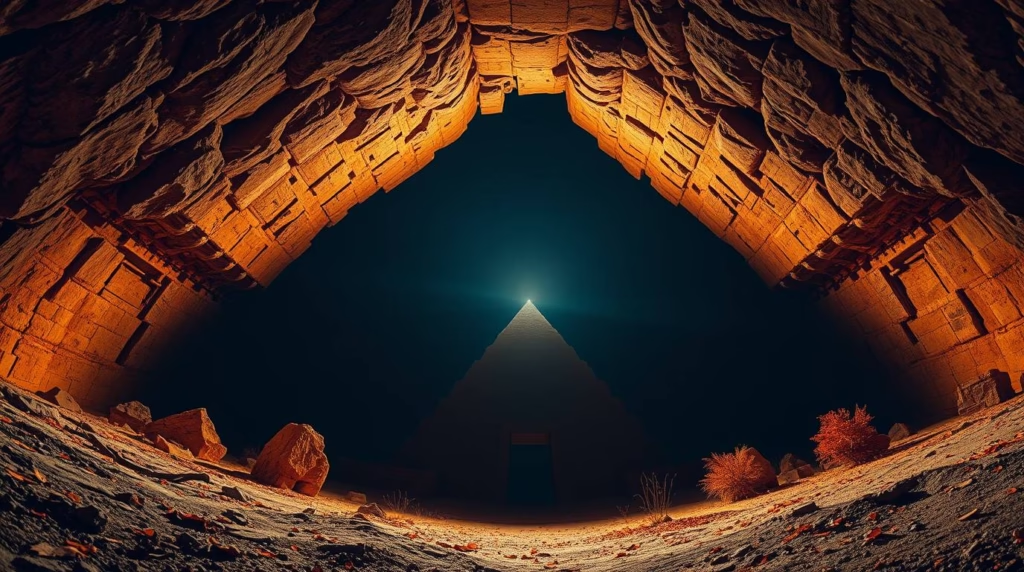
What Comes Next?
Currently, Egyptian authorities have halted further investigation at the site, citing national preservation laws. However, the international excitement remains. Researchers, historians, and enthusiasts continue to debate the data’s interpretation, demanding transparent publication of radar models.
The Timeless Tales HQ report promises that additional readings and modeling results will be released later in 2025, potentially through peer-reviewed channels. Until then, the Giza megastructure remains an unsolved mystery—poised between myth and discovery.
Conclusion: The Giza Enigma Deepens
Whether the alleged underground city proves to be a geological curiosity, an ancient architectural wonder, or a misinterpreted radar illusion, it has already reignited public fascination with Egypt’s ancient secrets. The mere possibility of a two-kilometer complex hidden beneath humanity’s most iconic monuments compels both awe and skepticism.
If confirmed, this would represent the most extraordinary archaeological revelation in modern history—reshaping not just Egypt’s story, but the broader history of civilization itself. Until ground excavation and evidence verification are permitted, the world watches closely, wondering whether under the desert sands of Giza lies a silent city… waiting to rewrite history.
for more exciting NEWS visit BB