Black Sea Marine Mammal Deaths: How War Noise and Pollution Fuel a Crisis
Since Russia’s 2022 invasion of Ukraine, thousands of dead dolphins and porpoises along Black Sea shores have spotlighted the overlapping threats of military sonar, starvation, fishing gear, and industrial pollution. While researchers debate exact basin-wide death tolls due to wartime data limits, international conservation bodies are already drafting a post-war recovery roadmap.
Key Highlights
- A July 28, 2026 EPL field report recorded 40 dead cetaceans (37 harbor porpoises, 2 bottlenose dolphins, 1 common dolphin) along 39 km of Tuzly Lagoons National Nature Park coast on June 5-6.
- Dr. Ivan Rusev estimated at least 50,000 deaths in the war’s first year from ~2,500 documented carcasses across Ukraine, Bulgaria, and Romania using a 5% wash-ashore assumption, and later suggested to Al Jazeera in October 2026 that losses could exceed 120,000—though the latter figure lacks published methodology and independent verification.
- Scientists including Dr. Pavlo Goldin emphasize that no single factor explains the crisis, citing military sonar, underwater explosions, depleted food sources, chemical pollution, stress, and infections.
- CEOBS documented heavy wartime damage at Mariupol’s Azovstal steel plant—hit by 714 tons of TNT equivalent in one month according to mayoral adviser Petro Andriushchenko—raising risks of lead, arsenic, and hydrocarbon runoff into the Sea of Azov.
- In 2025, ACCOBAMS adopted Resolution 9.10 outlining a post-war conservation roadmap featuring systematic monitoring, necropsies, mine clearance, marine protected areas, and aerial surveys.
Understanding Black Sea Marine Mammal Deaths in the Shadow of War
Along the southern shores of the Black Sea near Samsun, childhood encounters with marine wildlife have long revealed how vulnerable this semi-enclosed basin can be. Years before armed conflict reshaped the northern coastline, a young resident found a stranded dolphin larger than themselves resting on the sand.
Touching its smooth skin and listening to its labored breathing, they repeatedly tried to guide the animal back into deeper water, only to watch it return to shore each time until Greenpeace was contacted and the dolphin disappeared by the following morning. That unresolved memory now resonates across a far wider ecological emergency: Black Sea marine mammal deaths have become one of the most visible environmental consequences of Russia’s full-scale invasion of Ukraine launched in 2022.
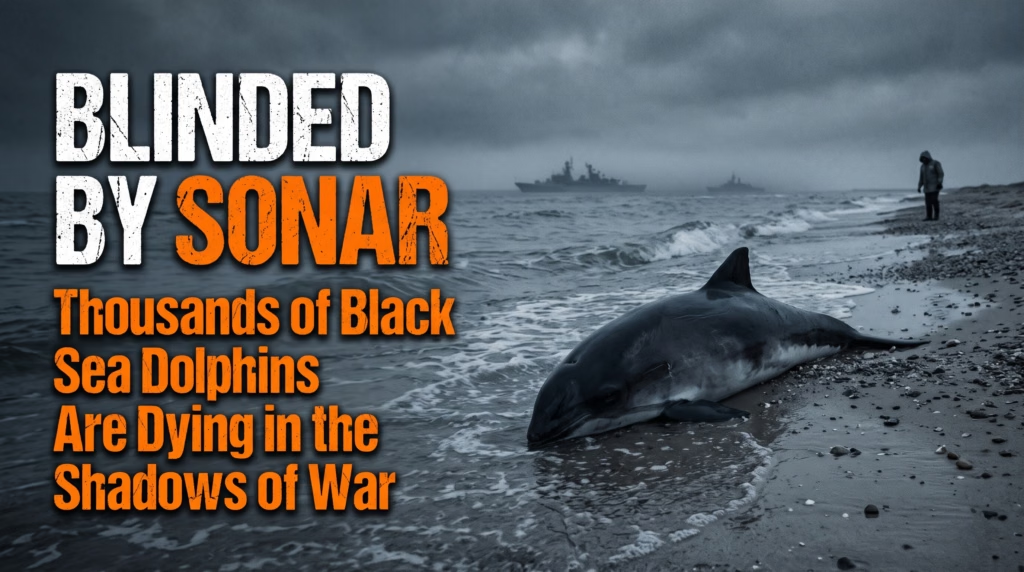
Cetaceans—including harbor porpoises, bottlenose dolphins, and common dolphins—depend on far more than eyesight to survive in murky coastal and offshore waters. Through echolocation, they emit rapid acoustic signals and interpret returning echoes to map underwater contours, coordinate with pod members, and locate fast-moving fish. Since 2022, however, high-intensity naval operations have transformed the northern Black Sea’s underwater soundscape. Underwater explosions, military sonar sweeps, and rising chemical contamination from conflict-damaged sites have introduced intense overlapping pressures across habitats already strained by decades of regional ecological stress.
Carcasses washing ashore along Ukrainian beaches represent the starkest indicator of this crisis, yet marine biologists emphasize that no single mechanism explains all recorded fatalities. Acoustic trauma, dwindling prey availability, incidental entanglement in fishing gear, infectious disease, and toxic pollutants interact simultaneously, making scientific attribution both urgent and exceptionally complex.

Tuzly Lagoons Strandings and the Scale of Cetacean Losses
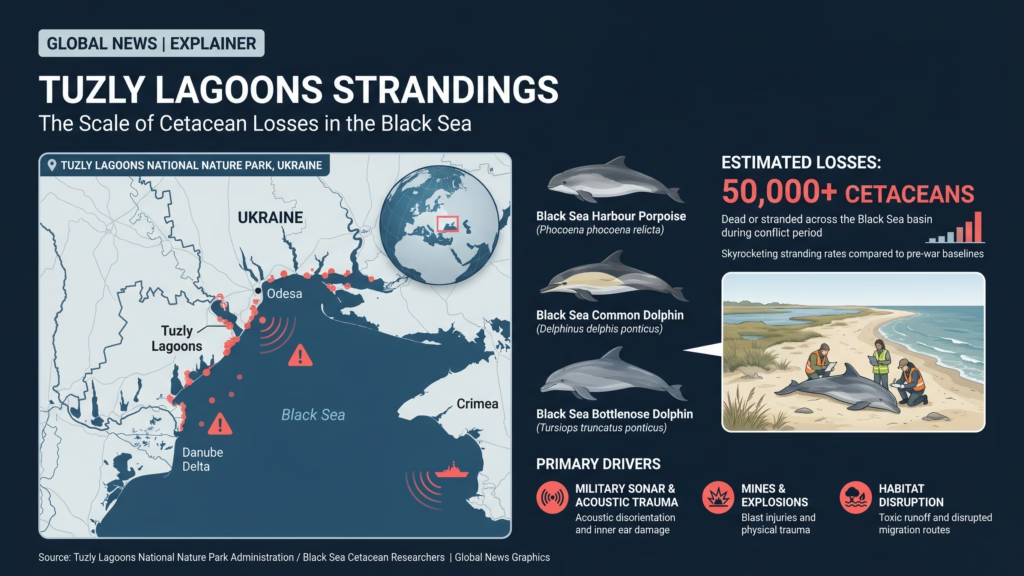
Systematic coastal monitoring by Ukrainian researchers offers rare concrete evidence from areas closest to active maritime hostilities. At Tuzly Lagoons National Nature Park, Head of Research Dr. Ivan Rusev has spent years documenting cetacean strandings along the park’s barrier beaches. According to a July 28, 2026 field report released by the Ukrainian environmental organization Environment-People-Law (EPL), survey teams recorded 40 dead marine mammals along a 39-kilometer coastal stretch of the national park across just two days, June 5 and June 6. Species identification underscored how heavily smaller coastal cetaceans are affected: 37 of the carcasses were harbor porpoises, alongside two bottlenose dolphins and a single common dolphin.
A separate June stranding summary compiled by Rusev highlighted additional forensic details that complicate cause-of-death assessments. Several carcasses discovered along the shoreline had already been dead for more than a month before currents pushed them onto land, resulting in widely varying stages of decomposition. Where bodily condition could still be evaluated, researchers noted stark physical deterioration, including severe emaciation and heavily depleted fat reserves. Such findings suggest that even when animals survive immediate blast shockwaves or acoustic disorientation, prolonged disruption to feeding behavior may trigger fatal nutritional decline weeks before bodies ever reach the coast.
Translating localized shoreline counts into basin-wide mortality totals remains one of the sharpest points of scientific uncertainty. In 2022, Rusev developed an initial wartime estimate based on roughly 2,500 dead marine mammals documented along the coasts of Ukraine, Bulgaria, and Romania.
Working from the assumption that only five percent of cetaceans that die at sea eventually wash ashore, that calculation suggested at least 50,000 marine mammals may have perished during the first year of the invasion. In an October 2026 assessment shared with Al Jazeera, Rusev estimated that cumulative deaths since the war began might have surpassed 120,000. Yet independent specialists caution that the exact methodology behind the 120,000 projection has not been published in full detail and currently lacks independent scientific verification.
| Assessment or Survey | Date or Period | Geographic Coverage | Reported Figures and Scope | Key Methodological Notes |
|---|---|---|---|---|
| Pre-war aerial baseline survey | June 19 – July 4, 2019 (15 flight days) | Roughly 52% of the Black Sea basin | Multi-species cetacean abundance reference | Reflects only a brief midsummer window; cannot be generalized basin-wide |
| Multi-country coastal stranding compilation | 2022 | Coasts of Ukraine, Bulgaria, and Romania | Approximately 2,500 recorded dead marine mammals | Direct shoreline counts shaped by access limits and currents |
| First-year war mortality projection (Rusev) | 2022 | Black Sea basin extrapolation | At least 50,000 estimated deaths | Relies on assumption that only 5% of dead cetaceans wash ashore |
| EPL Tuzly Lagoons field report | June 5-6, 2026 (published July 28, 2026) | 39 km coast of Tuzly Lagoons National Nature Park | 40 carcasses: 37 harbor porpoises, 2 bottlenose, 1 common dolphin | Localized two-day survey; some bodies over one month old or emaciated |
| Cumulative wartime estimate (Al Jazeera) | October 2026 | Black Sea basin since 2022 invasion | Potentially over 120,000 dead marine mammals | Detailed calculation methodology unpublished; lacks independent verification |
Underwater Noise, Military Sonar, and Acoustic Trauma
Among marine mammalogists studying the region, there is broad consensus that wartime mortality stems from intersecting stressors rather than a single isolated trigger. Dr. Pavlo Goldin, a marine mammal specialist at the Schmalhausen Institute of Zoology of the National Academy of Sciences of Ukraine, has repeatedly emphasized that Black Sea fatalities cannot be attributed to one lone factor. According to Goldin, researchers must evaluate infectious diseases, physical injuries linked to sonar and underwater mine detonations, chemical pollution, chronic physiological stress, and shrinking prey populations simultaneously in order to understand how conflict reshapes cetacean survival.
Acoustic disturbance occupies a central position in that risk matrix because sound travels roughly four times faster in seawater than in air, allowing high-energy military transmissions and explosions to propagate across vast marine corridors. Intense naval sonar pings and underwater blasts from mines or ordnance can damage delicate auditory structures and scramble echolocation signals. When a dolphin or porpoise loses acoustic clarity, its core survival functions falter at once: navigating away from coastal hazards becomes unreliable, vocal cohesion within social groups breaks down, and tracking schools of small pelagic fish turns markedly harder.
Pinpointing acoustic trauma as the decisive cause of death in any individual stranding, however, demands forensic evidence that wartime conditions rarely permit. Confirming inner-ear hemorrhage, gas-bubble lesions, or blast-induced organ damage requires fresh tissue samples examined through comprehensive laboratory histopathology and necropsies. Because active combat restricts shoreline patrols and drifting carcasses frequently spend weeks decomposing at sea before washing onto Tuzly Lagoons or neighboring beaches, tissue degradation often erases the microscopic signatures needed to prove acoustic injury beyond scientific doubt.
Starvation, Blubber Breakdown, and Secondary Toxin Exposure
Beyond direct physical trauma, researchers are examining an indirect biological cascade linking underwater noise to internal chemical poisoning. If persistent naval activity and explosions interfere with echolocation or drive prey fish away from traditional feeding grounds, dolphins and porpoises consume fewer calories over extended periods. Field observations of severely emaciated carcasses with exhausted fat stores along Ukrainian beaches align with this pattern of sustained nutritional deficit, forcing distressed animals to rely heavily on stored energy reserves merely to stay alive.
Dr. Ivan Rusev has proposed that this starvation response could expose marine mammals to a dangerous secondary wave of toxins already stored inside their own bodies. Persistent organic pollutants—fat-soluble industrial and agricultural chemicals that linger in marine food webs—gradually accumulate inside cetacean blubber over years of feeding. Under normal nutritional conditions, these compounds remain largely sequestered within adipose tissue. When severe food scarcity forces an animal to rapidly metabolize its blubber reserves, stored pollutants can be mobilized back into the bloodstream, potentially straining vital organs and weakening immune defenses against infections.
Biological studies conducted on other cetacean and pinniped species outside the Black Sea confirm that lipid mobilization during fasting can elevate circulating pollutant concentrations. Nevertheless, scientists maintain an important evidentiary distinction: while the underlying physiological mechanism is well documented elsewhere, researchers have not yet directly measured or proven the exact degree to which blubber-released pollutants are driving ongoing Black Sea marine mammal deaths.
Industrial Warfare, Azovstal Contamination, and Marine Pollution
Chemical threats to regional marine life extend well beyond legacy toxins already circulating in cetacean tissues. Environmental monitoring groups warn that military strikes on heavy industrial infrastructure along the northern coastline risk injecting fresh pulses of hazardous substances into fragile marine basins. According to analyses by the Conflict and Environment Observatory (CEOBS), combat damage to metallurgical complexes, chemical plants, and waste containment systems creates pathways for acute and chronic water contamination across connected coastal ecosystems.
One of the most prominent industrial flashpoints documented during the conflict is the Azovstal iron and steel plant in Mariupol, situated directly beside the Sea of Azov. On May 19, 2022, Petro Andriushchenko, an adviser to the mayor of Mariupol, reported that the sprawling industrial site had been struck by aerial bombs totaling 714 tons of TNT equivalent within the span of a single month. Separate assessments compiled by CEOBS detailed structural destruction across Azovstal’s blast furnaces, coke production units, electrical substations, and wastewater treatment facilities—systems specifically designed to contain toxic byproducts and prevent industrial runoff.
When containment infrastructure fails under heavy bombardment, decades of accumulated industrial residues can mobilize into surrounding soils and coastal waters. CEOBS analysts highlighted a concrete risk that lead, arsenic, and petroleum hydrocarbons embedded in Azovstal’s historical pollution load could leach into the shallow Sea of Azov, which exchanges water directly with the Black Sea through the Kerch Strait. Because heavy metals and hydrocarbons persist in sediments and bioaccumulate up the food chain, industrial damage from 2022 carries ecological implications that can endure for years, compounding the health burdens already facing dolphins and porpoises.
| Threat Vector | Conflict or Environmental Source | Documented or Hypothesized Impact | Verification and Evidence Status |
|---|---|---|---|
| Underwater acoustic trauma | Military sonar, mines, and explosions | Hearing loss, echolocation disruption, navigation errors | Mechanism established; individual cases require fresh tissue labs |
| Starvation and endogenous toxins | Disrupted hunting and fat-reserve depletion | Emaciation and potential blubber pollutant re-entry into blood | Mechanism supported in other species; Black Sea role unproven |
| Industrial chemical runoff | Strikes on plants such as Azovstal (714 tons TNT eq.) | Release of lead, arsenic, and hydrocarbons into Sea of Azov | Infrastructure damage documented by CEOBS; marine dose unquantified |
| Fishing net entanglement | Displacement to unfamiliar southern coastal waters | Accidental bycatch and drowning in commercial or artisanal gear | Reported as elevated risk by Bulgarian conservation experts |
| Food-web destabilization | Sustained loss of cetacean predators | Altered fish population dynamics and lower trophic imbalance | Long-term impact requires comprehensive ecological monitoring |
Regional Displacement and Black Sea Marine Mammal Deaths
Although the heaviest naval fighting and coastal bombardment have concentrated in the north and northwest, acoustic shockwaves and habitat disturbances ripple across international maritime boundaries. In a 2022 interview with Bulgarian National Radio’s BNR Burgas, Dimitar Popov of the Bulgarian environmental organization Green Balkans observed that escalating underwater noise in northern waters may have pushed significant numbers of cetaceans southward toward quieter coastal zones off Bulgaria and neighboring states.
At first glance, fleeing loud combat zones for calmer waters appears adaptive, yet rapid range shifts carry serious hidden dangers for coastal species like the harbor porpoise. Entering unfamiliar southern waters forces displaced animals to forage near dense networks of bottom-set gillnets and commercial fishing gear without prior spatial familiarity. Combined with stress or impaired echolocation, this sudden overlap sharply increases the likelihood of accidental entanglement—often called bycatch—which prevents air-breathing marine mammals from surfacing and results in fatal drowning.
The ripple effects of sustained cetacean losses also extend downward through the entire marine ecosystem. As apex and mesopredator species, dolphins and harbor porpoises help regulate prey fish populations and maintain trophic equilibrium within a sea already vulnerable to overfishing, warming waters, and nutrient pollution. Removing tens of thousands of predators—if higher estimates prove accurate—could trigger unpredictable shifts in fish abundance and lower trophic levels, underscoring why biologists call for coordinated basin-wide ecological monitoring rather than isolated national counts.

Research Limits, Pre-War Baselines, and the Challenge of Scientific Proof
Determining the true scale of wartime cetacean mortality is extraordinarily difficult even under peaceful conditions, and active warfare multiplies every methodological obstacle. Marine biologists note that most cetaceans dying offshore sink or are consumed by scavengers long before reaching land, while wind patterns and surface currents determine where floating carcasses drift. Extrapolating total deaths from shoreline finds—such as applying a five percent wash-ashore assumption—introduces wide margins of uncertainty, especially when coastal patrols cannot access mined beaches or restricted military zones across much of Ukraine’s coast.
Understanding population-level impacts also depends on reliable pre-war benchmarks, yet existing baseline records remain geographically and seasonally partial. Between June 19 and July 4, 2019, international researchers conducted coordinated aerial surveys across 15 days of favorable weather, covering approximately 52 percent of the Black Sea. While that 2019 campaign generated invaluable pre-invasion reference data on cetacean distribution and density, scientists explicitly caution that observations gathered during a brief two-week summer window cannot be generalized across the entire basin or extrapolated to winter and spring seasons.
Since 2022, closed airspace has prevented follow-up basin-wide aerial surveys, leaving conservationists reliant on fragmented shore monitoring, satellite environmental data, and sporadic stranding reports like the June 2026 Tuzly Lagoons survey. That observational gap explains why figures such as 50,000 first-year deaths or 120,000 cumulative fatalities trigger intense public concern alongside cautious scientific scrutiny. Without published statistical models, standardized necropsy protocols, and independent peer verification, researchers stress the importance of separating documented field counts from unverified projections when assessing Black Sea marine mammal deaths.
ACCOBAMS Resolution 9.10 and the Post-War Conservation Roadmap
Despite active hostilities preventing full-scale offshore science, international conservation bodies have begun laying institutional groundwork for ecological recovery. In 2025, parties to the Agreement on the Conservation of Cetaceans of the Black Sea, Mediterranean Sea and Contiguous Atlantic Area (ACCOBAMS) adopted Resolution 9.10, formally calling for a coordinated roadmap toward a post-war conservation plan dedicated to Black Sea cetaceans. Rather than waiting for hostilities to conclude before designing policy, the resolution establishes technical priorities that regional governments and research institutes can mobilize as soon as maritime access improves.
The annex accompanying ACCOBAMS Resolution 9.10 outlines a comprehensive multi-stage recovery framework anchored in empirical science and habitat restoration. First, it prioritizes systematic ecological monitoring alongside standardized necropsies and tissue sample archiving so laboratories can definitively distinguish acoustic trauma, infectious pathogens, starvation, and chemical toxicants. Second, it emphasizes maritime mine clearance to remove explosive hazards for both vessels and migrating wildlife. Third, the roadmap calls for strengthening and expanding marine protected areas and executing new post-war aerial surveys to measure surviving population sizes against the 2019 baseline.
Implementing that roadmap will require sustained cross-border cooperation among Black Sea littoral states, environmental agencies, and international donors long after guns fall silent. For scientists like Pavlo Goldin and Ivan Rusev, as well as regional observers such as Dimitar Popov and CEOBS analysts, every carcass documented on the sand represents both a biological loss and an urgent data point demanding rigorous investigation.
Decades ago on the beach in Samsun, a child watched an exhausted dolphin slip back into the surf and never discovered whether it survived. Today, the uncertainty surrounding Black Sea marine mammal deaths spans an entire sea, stretching from bombed industrial plants in Mariupol to lagoons in southern Ukraine and fishing waters off Bulgaria. Answering what happened—and ensuring Black Sea cetaceans can recover—will depend on transparent science, toxic cleanup, mine clearance, and enduring international commitment to protecting the marine ecosystem.
Frequently Asked Questions (FAQ)
Why are marine mammals dying in the Black Sea during the Russia-Ukraine war?
Marine biologists such as Dr. Pavlo Goldin emphasize that no single cause accounts for all deaths. Instead, dolphins and harbor porpoises face overlapping wartime pressures, including high-intensity military sonar, underwater mine explosions, disrupted hunting leading to starvation, accidental entanglement in fishing nets after shifting southward, infectious diseases, and chemical pollution.
How many dolphins and porpoises have washed ashore in documented surveys?
In 2022, Dr. Ivan Rusev compiled roughly 2,500 documented dead marine mammals across the coasts of Ukraine, Bulgaria, and Romania. More recently, a July 28, 2026 field report by Environment-People-Law (EPL) recorded 40 carcasses—37 harbor porpoises, two bottlenose dolphins, and one common dolphin—along a 39-kilometer stretch of Tuzly Lagoons National Nature Park on June 5-6, 2026.
Why is the 120,000 Black Sea marine mammal death estimate scientifically debated?
While Dr. Ivan Rusev told Al Jazeera in October 2026 that total wartime losses since 2022 may have exceeded 120,000, the exact statistical methodology behind that figure has not been published in detail and lacks independent scientific verification. Earlier 2022 estimates of at least 50,000 deaths also relied on the broad assumption that only five percent of dead animals wash ashore.
How do military sonar and explosions harm dolphins and porpoises?
Dolphins and porpoises rely on echolocation—emitting sounds and reading echoes—to navigate, communicate, and hunt prey. High-decibel military sonar and underwater blasts can injure auditory tissues and scramble echolocation, causing disorientation and foraging failure. Confirming acoustic trauma in specific fatalities requires fresh tissue samples and detailed laboratory analysis.
Could war damage at the Azovstal steel plant pollute Black Sea waters?
Yes. Mariupol mayoral adviser Petro Andriushchenko reported on May 19, 2022 that Azovstal was struck by 714 tons of TNT equivalent in aerial bombs over a single month. The Conflict and Environment Observatory (CEOBS) documented damage to blast furnaces, coke production units, substations, and wastewater treatment plants, creating risks that lead, arsenic, and hydrocarbons could spread into the Sea of Azov and connected waters.
What is ACCOBAMS Resolution 9.10 for Black Sea cetacean conservation?
Adopted in 2025, ACCOBAMS Resolution 9.10 calls for a roadmap toward a post-war conservation plan for Black Sea whales, dolphins, and porpoises. Its annex outlines comprehensive monitoring, necropsies and tissue sample analysis, naval mine clearance, marine protected areas, and new post-war aerial population surveys.
for more latest news analysis visit Bulletinbuzzs