China’s Maglev Train Hits 700 km/h in Just Two Seconds, Setting a New Global Record
In a groundbreaking scientific and engineering achievement, China has once again set the world abuzz by breaking another speed record in transportation. Scientists in China have successfully developed and tested a futuristic Maglev (magnetic levitation) train that accelerated to 700 kilometers per hour (km/h) in only two seconds, marking a new world record. This astonishing milestone signals a massive leap forward in the field of high-speed rail and underscores China’s dominance in cutting-edge transport technology.
This record-shattering test not only demonstrates the country’s growing technological maturity but also highlights a future where travel between distant cities could take mere minutes instead of hours. The experiment, performed under strict scientific protocols, marks a historic moment in the quest for faster, safer, and more efficient terrestrial travel.
The Fastest Train in the World: A Magnetic Levitation Wonder
Unlike traditional trains that rely on wheels and tracks, the Maglev Train operates on a totally different principle. It “floats” above the track using superconducting magnetic levitation technology, which virtually eliminates friction between the train and rail. This allows the train to achieve unprecedented levels of speed, stability, and efficiency.
During the recent test, Chinese researchers were able to propel a tonne-class superconducting Maglev prototype to the staggering speed of 700 km/h on a 400-meter-long magnetic track. The acceleration was so intense that it reached its top speed in just two seconds—a feat comparable to the thrust used in launching small aircraft.
Even more impressive is the fact that the vehicle came to a smooth stop within seconds, demonstrating not only its raw power but also the precision control embedded in its braking and stabilization systems. The test was carried out at the National University of Defense Technology (NUDT), one of the leading innovation hubs in China’s defense and transport research sector.
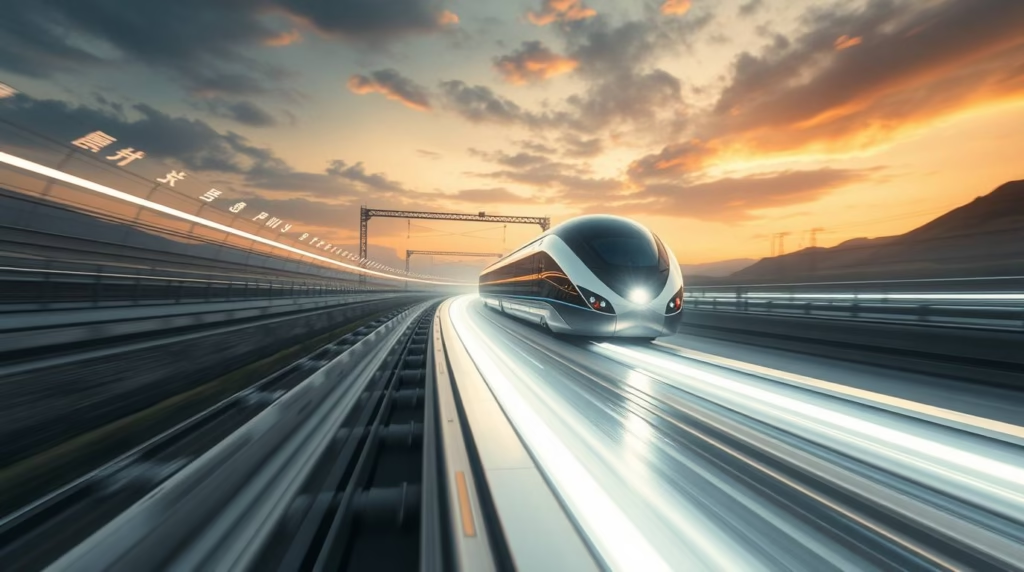

Inside the Historic Test: How China Broke a World Record
The successful test took place under the careful supervision of engineers and scientists who have spent years perfecting the superconducting Maglev system. Using an advanced experimental setup, the team at NUDT demonstrated how magnetic levitation can achieve extraordinary acceleration within a confined space.
Earlier in 2025, the same research group conducted an earlier test where the Maglev reached 648 km/h, already one of the highest speeds ever recorded for a train. But this latest test shattered that record. With subtle improvements to magnet strength, aerodynamic design, and control software, the Maglev train achieved 700 km/h almost instantly—an achievement that transcends previous benchmarks in rail engineering.
Despite the short 400-meter test track, the results prove that the potential top speed of Maglev trains could one day rival or even surpass the cruising speeds of commercial jet aircraft. The Chinese state broadcaster CCTV released footage of the test, showing the silver-scaled train whizzing past the camera in the blink of an eye, appearing as a shimmering bolt of light streaking through fog. Many viewers compared the sight to scenes from futuristic science fiction films, as the vehicle left behind a fine mist cloud from the sheer force of its movement.
Understanding Maglev Technology: The Physics Behind the Speed
To grasp the significance of this achievement, it helps to understand how magnetic levitation works. The technology relies on a complex interaction of electromagnetic forces between superconducting magnets on the train and a specially designed metal track. By creating a magnetic repulsion force, the train effectively lifts off the surface of the rail, removing any physical contact. This eliminates rolling resistance, which is the main limiting factor in traditional high-speed trains.
Because there is no wheel-to-track friction, Maglev trains can travel at much higher speeds without the typical mechanical wear and tear. The only resistance they face is air drag, which can be minimized using aerodynamic shaping. The superconducting nature of the magnets also means the system operates efficiently, consuming less energy compared to equivalent power outputs.
This floating mechanism not only makes Maglev trains faster, but also quieter, smoother, and more stable than conventional rail systems. For passengers, it translates to a serene, vibration-free ride even at extreme velocities.
The Research Team Behind the Breakthrough
The test at the National University of Defense Technology represents more than just a technological trial—it’s the culmination of nearly a decade of research and innovation. The university has long been a pioneer in advanced electromagnetic propulsion systems. Its scientists began developing prototype Maglev systems years ago, building on foundational work that contributed to China’s first manned Maglev train.
Over the years, the NUDT team refined numerous components: powerful cryogenic superconducting magnets, advanced magnetic field control systems, and lightweight vehicle frames capable of withstanding enormous aerodynamic pressures. Their work has placed China at the forefront of global Maglev engineering, outpacing other nations that began similar research much earlier.
This remarkable progress is also part of a broader push by the Chinese government to revolutionize national infrastructure and promote sustainable, high-efficiency public transport systems.
How the Maglev Train Differs from Traditional High-Speed Rail
While modern bullet trains like the Shinkansen in Japan or Fuxing trains in China can already travel at speeds of 300–400 km/h, Maglev technology manages to double that speed range. The secret lies in non-contact motion, which removes friction altogether.
Here’s how Maglev trains differ fundamentally from standard electric or diesel-powered rail:
-
No wheels or tracks: The train levitates above a guideway using magnetic forces, allowing extremely fast and smooth movement.
-
Near-zero friction: The absence of physical contact drastically reduces energy loss and mechanical damage.
-
Silent operation: Maglev trains produce minimal noise since there’s no metal-on-metal sound.
-
Higher efficiency: Energy is used primarily for propulsion instead of overcoming friction.
-
Less maintenance: No contact means fewer parts wear out, reducing long-term costs.
With these advantages, Maglev systems are positioned to redefine next-generation transportation, offering not just faster travel but also greater safety, durability, and efficiency.
Potential Beyond Rail Transport: A Revolution in Mobility
One striking aspect of this Chinese Maglev system is its potential applications beyond railways. According to NUDT researchers, the electromagnetic propulsion technology could play a key role in aviation and aerospace innovations. For example:
-
Aircraft launch systems: Maglev tracks could accelerate planes to takeoff speeds without relying heavily on jet fuel, reducing runway length and emissions.
-
Space systems: The same underlying principles could support spacecraft launch assist systems, slashing energy consumption.
-
Cargo logistics: High-speed linear propulsion could revolutionize freight transport, offering ultra-fast cargo delivery networks.
By exploring these broader uses, China’s Maglev research could benefit industries far beyond passenger travel, integrating advanced levitation and acceleration technologies into multiple sectors.
China’s Commitment to Transportation Innovation
China’s consistent investments in transportation infrastructure and research and development (R&D) have turned the country into a leader in global rail technology. From operating the world’s longest high-speed rail network to pioneering superconducting Maglev systems, China’s focus on innovation is clear. Authorities view Maglev technology as part of the broader strategy to build a greener, faster, and more connected nation.
Several Chinese cities—such as Shanghai, Chengdu, and Qingdao—are already experimenting with or planning to deploy Maglev systems for passenger transit. Shanghai, in fact, houses the world’s first commercial Maglev train line, which connects the city center to Pudong International Airport and operates at top speeds of around 431 km/h. The new high-performance prototypes could one day extend this capacity to intercity Maglev routes, cutting major travel times dramatically.
The Environmental Advantage of Maglev Technology
Beyond speed and innovation, Maglev systems have strong environmental benefits. Since the train uses electromagnetic propulsion instead of combustion, it produces zero direct emissions. Moreover, because the train glides without friction, it requires less energy than high-speed wheeled trains at equivalent speeds.
As countries around the world face pressure to reduce carbon emissions, sustainable high-speed transport systems like China’s Maglev are increasingly seen as crucial to achieving environmental targets. The quiet operation, reduced land usage (compared to airports), and long service life make Maglev an attractive option for eco-friendly urban mobility.
What This Means for the Future of Travel
The 700 km/h speed milestone signals more than just an engineering triumph—it’s a preview of how the future of transportation might look. If this technology becomes scalable for commercial use, passengers could travel between Beijing and Shanghai, a distance of about 1,200 kilometers, in just under two hours.
This would completely transform business, tourism, and urban planning dynamics across large countries. The day may soon come when traveling from Guangzhou to Wuhan or Delhi to Mumbai by Maglev train will feel like taking a short domestic flight—except faster, quieter, and cleaner.
Such advances will also reshape global competitiveness in the rail industry. China’s success positions it as a key exporter of next-generation high-speed transit systems, attracting interest from nations seeking improved mobility solutions.
Challenges Still Ahead
Although the recent world record is an extraordinary accomplishment, the path to commercial deployment remains complex. Several challenges still need to be addressed:
-
Infrastructure cost: Maglev tracks require specialized guideways made of expensive materials that can sustain strong magnetic fields.
-
Energy demands: Despite efficiency at high speeds, maintaining superconducting magnets requires cooling systems that consume significant energy.
-
Scalability: Translating small-scale experimental results into full-size intercity networks will require new engineering solutions.
-
Safety standards: Ultra-high speeds mean new safety frameworks for passengers, emergency systems, and control networks.
Chinese engineers are already working to solve these challenges through more efficient superconductors, lighter materials, and improved control algorithms.
Why China Leads the Maglev Revolution
Several factors explain why China has emerged as the primary global driver in Maglev development:
-
Long-term funding and vision: The government’s continuous investment in rail innovation ensures research programs stay active for decades.
-
Unified national strategy: Central coordination between universities, companies, and local governments speeds up pilot deployment.
-
Technical ecosystem: China houses advanced magnetics, electronics, and manufacturing industries—all critical to Maglev success.
-
Public commitment: The nation views transport modernization as a symbol of technological strength and progress.
This combination of vision, funding, and talent makes China’s Maglev efforts stand out. While other countries experiment with prototypes, China has moved past concept to real-world demonstrations that consistently push performance limits.
The Road Ahead: From Prototype to Passenger Service
Experts estimate that it could take five to ten years before 700 km/h-class Maglev trains enter full commercial service. The next steps will likely include building longer testing tracks, optimizing passenger cabin designs, and conducting safety certification trials.
China’s strategic plan may also include establishing regional Maglev corridors connecting major economic zones, such as the Beijing–Tianjin–Hebei region or the Yangtze River Delta. Once operational, these routes could support daily high-speed commuting, reshaping how people live, work, and travel across the country.
In parallel, export partnerships may allow Chinese rail technology to appear in international projects—from the Middle East’s desert corridors to Europe’s eco-mobility initiatives.
FAQs on China’s Maglev Train Record
1. What speed did the Maglev Train reach in China?
It reached 700 km/h in just two seconds, setting a new world record for high-speed rail acceleration.
2. Why is this Maglev Train faster than normal trains?
It levitates above the track using superconducting magnets, removing friction entirely, which allows it to accelerate much faster than traditional trains.
3. Is this train ready for public use?
Not yet. It’s currently in the testing phase, but the results suggest enormous potential for future commercial deployment.
4. Could this technology be used in other sectors?
Yes. The electromagnetic propulsion system could also support aviation, space launch systems, and hyper-speed cargo networks.
5. Why is China leading in Maglev research?
Because of persistent national investment, strong collaboration across universities and industries, and a clear long-term strategy for innovation in high-speed transportation.
Conclusion
China’s latest record-breaking test of its superconducting Maglev Train, hitting 700 km/h in just two seconds, showcases what human ingenuity can achieve when engineering, physics, and vision combine. This world record cements China’s leadership in the evolution of ultra-high-speed land travel, pushing humanity closer to a future where cities, countries, and even continents are connected at near-airplane speeds—without ever leaving the ground.
As research continues, the dream of frictionless, zero-emission, lightning-fast travel is no longer a concept in science fiction—it’s becoming a reality, thanks to China’s bold and relentless pursuit of the future of transportation.
for more interesting articles visit BB