
Mystery of Egypt’s ‘Area 51’: Unearthing the Secrets of Zawyet El Aryan
Just a few miles away from the majestic Pyramids of Giza lies one of the most mysterious, restricted, and lesser-known archaeological sites in Egypt — a location that has fascinated explorers, historians, and UFO enthusiasts alike. Known as Zawyet El Aryan, this enigmatic complex has often been dubbed Egypt’s ‘Area 51’ due to its secrecy, its supposed connection to lost ancient technologies, and the many unanswered questions surrounding its purpose.
While the famous pyramids of Giza and Saqqara continue to draw millions of visitors every year, Zawyet El Aryan remains nearly forgotten — locked away behind military fences and shrouded in silence. But unearthed early 20th-century photographs, along with more recent research, have reignited public interest, revealing details about a massive T-shaped pit carved deep into solid limestone. The images, captured by researcher Derek Olsen, have gone viral online, stirring debates that blend archaeology, mythology, and extraterrestrial speculation.
A Hidden Monument Near the Pyramids
Zawyet El Aryan sits just three miles north of the Great Pyramid complex at Giza. The proximity alone makes the site significant — any monument that close to one of the world’s most iconic ancient locations is bound to be historically important. Yet, unlike the neatly preserved pyramids, the structures at Zawyet El Aryan appear incomplete.
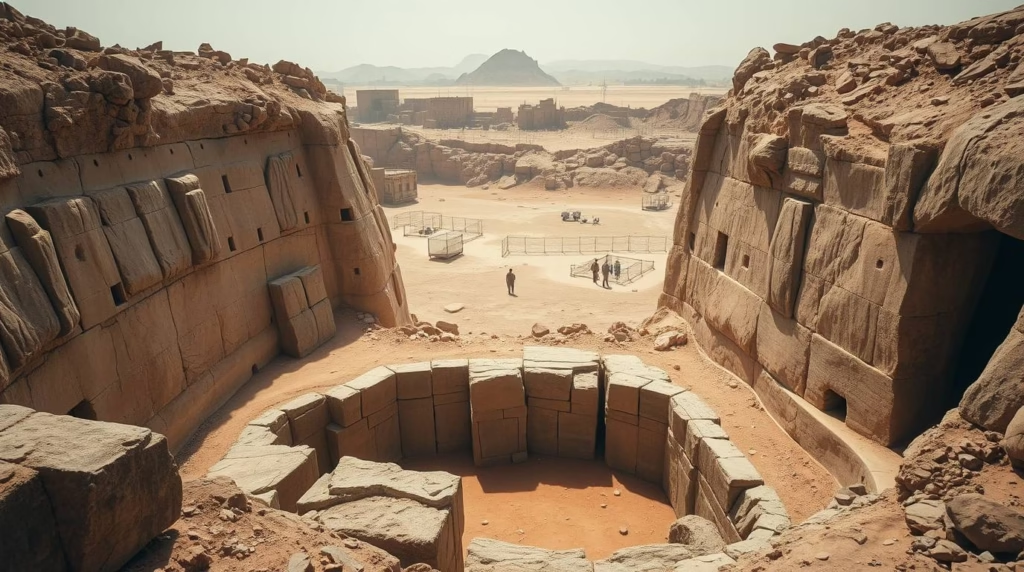
Archaeologists have long debated its origins. Was it an unfinished pyramid, a ceremonial site, or something far more extraordinary? The visible site includes a massive pit shaped somewhat like a T, stretching to nearly 100 feet deep, its interior walls lined with enormous granite blocks and precision-cut stonework rivaling the quality seen inside Egypt’s royal tombs.
The scale and engineering perfection of the stonework raise serious questions. Why would such immense effort be put into constructing something that apparently leads nowhere? And if it was abandoned midway, what halted construction so abruptly?
Discovery and Early Documentation
The first detailed exploration of Zawyet El Aryan dates back to the early 1900s when the Italian archaeologist Alessandro Barsanti excavated the area. Barsanti’s notes describe an astonishing level of craftsmanship — smoothed granite, perfectly joined limestone panels, and a massive central chamber that took shape beneath the ground. What he found amazed even the seasoned Egyptologist community at that time.
Barsanti described the site as containing a granite-lined vat or sarcophagus sealed with a heavy granite lid. Inside, it once held an unknown substance — long since removed or disintegrated — adding to the site’s mystery. The vat’s polished finish and complex construction suggested it was far more than a tomb or storage chamber.
Barsanti was captivated by what he called “the boldness of structure and peerless finish of the granite tank.” He believed the monument represented something unique in the canon of Old Kingdom architecture, emphasizing how its proportions and the precision of cuts were beyond comparison with other contemporary monuments.
He expressed a wish that future generations of travelers would have the privilege to admire it, predicting that “the size, the richness of the materials, and the perfection of the joints will astonish them.” Unfortunately, his hopes were never realized.

The ‘Gateway to the Stars’ Inscription
Perhaps the most haunting detail within Zawyet El Aryan is the ancient graffiti etched into its walls, bearing the word “Seba.” This term, according to Egyptologists, translates to “Gateway to the Stars.”
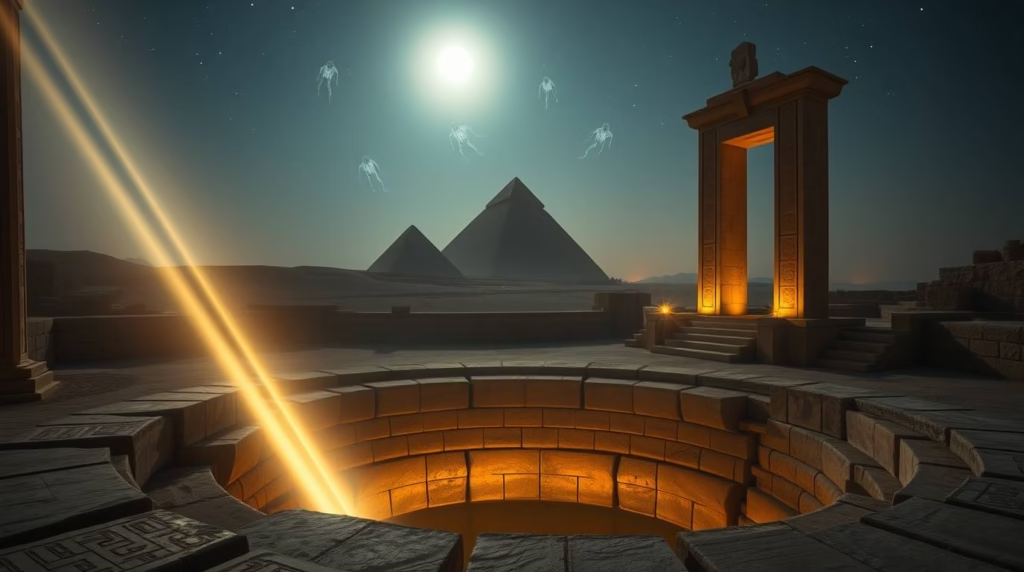
The phrase has sparked a storm of speculation across both archaeological and paranormal circles. Was the site designed as a symbolic passage to the afterlife — a cosmic gateway for the soul, as suggested by ancient Egyptian religious beliefs? Or did it serve another, more mysterious purpose connected to the stars themselves?
In ancient Egyptian cosmology, the stars were considered the eternal homes of the gods. The Pharaoh’s soul, in particular, was believed to join the circumpolar stars — the so-called “imperishable ones” — after death. Monuments like the pyramids were not just tombs; they were celestial machines built for cosmic rebirth.
Thus, the idea of Zawyet El Aryan being a gateway gains symbolic depth within Egyptian spirituality. Still, some researchers, including modern alternative theorists like Derek Olsen, have gone further, proposing that the site could have served as a kind of technology — an energetic or astronomical device meant to connect humanity with the heavens.
Derek Olsen’s Viral Discoveries
When American researcher Derek Olsen shared the rediscovered photos of Zawyet El Aryan online, he reignited global curiosity about what many have started calling “Egypt’s forbidden site.”
Olsen, who has spent years studying ancient anomalies around the world, believes there may have been a spiritual or even scientific purpose behind the pit’s creation. The unusual T-shape, he argues, is not random — it could have represented a cosmic map, an energy channel, or even a symbolic portal aligned with certain stars.
Olsen’s biggest question echoes Barsanti’s: “Why build such a vast, precise underground structure for no apparent reason?” After all, the effort required to quarry granite blocks of that size, then transport and fit them within a confined vertical shaft, would be staggering even with today’s machinery.
The Site’s Mysterious Seizure
In the 1960s, everything changed. The Egyptian military suddenly declared Zawyet El Aryan a restricted zone, permanently closing it off to tourists and researchers alike. Public access was banned, and aerial photography of the area was prohibited.
Over time, reports surfaced that military construction had taken place directly atop the archaeological zone. Satellite images appear to show bungalow-like structures built over what may be the ancient entrances. Some rumors even suggest that the pit has been used to dump waste material — a sad fate for one of Egypt’s most puzzling historical sites.
The decision to close the area has fueled countless conspiracy theories. Some believe that the military wants to protect fragile artifacts or prevent looting. Others think authorities are concealing something far more extraordinary — evidence that could rewrite history or contradict accepted narratives about Egypt’s past.

Comparing to America’s Area 51
It is no coincidence that Zawyet El Aryan has earned the nickname “Egypt’s Area 51.” Much like Area 51 in the Nevada desert — officially known as Groom Lake or Homey Airport — the Egyptian counterpart is defined by secrecy, restricted access, and rumors of otherworldly involvement.
The real Area 51, a highly classified U.S. Air Force installation established in 1955, became globally famous due to persistent rumors linking it with UFO research and alien technology. The CIA only officially acknowledged its existence in 2013, and even today, all operations conducted there remain highly classified under “Top Secret/Sensitive Compartmented Information.”
Zawyet El Aryan provokes similar intrigue, albeit in an archaeological context. Instead of futuristic spacecraft, the Egyptian site hides ancient stonework of inexplicable precision. Instead of experimental aircraft, the mystery revolves around rituals, technology, and lost knowledge from thousands of years ago.
Theories About Its Purpose
Over the decades, researchers have proposed multiple explanations for the Zawyet El Aryan complex:
-
Unfinished Pyramid Hypothesis: Traditional Egyptologists maintain that the pit and surrounding foundation represent the base of an unfinished pyramid, possibly from the Fourth Dynasty. Construction might have ceased due to the pharaoh’s sudden death or political change.
-
Ceremonial Complex Theory: Others view it as a ritual site associated with the cult of the sun, where priests performed sacred rites connected to rebirth or star alignment.
-
Astronomical Alignment Model: Alternative researchers note the structure’s orientation, suggesting that it was deliberately aligned with certain star systems, possibly Orion or Sirius, echoing the stellar symbolism of the Giza pyramids.
-
Ancient Technology Concept: The most speculative — yet widely discussed — theory claims that the pit was a machine of sorts: a resonant chamber or energy field generator for space or spiritual travel. The granite composition, known for its piezoelectric properties, only deepens this mystery.
Each interpretation reveals a different layer of meaning. Where traditional archaeologists see an unfinished monument, alternative historians see evidence of advanced knowledge lost to time.
Materials and Construction Excellence
One cannot overlook the engineering valor of Zawyet El Aryan. Granite, requiring immense effort to shape, was transported over long distances, possibly from Aswan — more than 500 miles away. The precision with which those blocks were fitted within the limestone structure is breathtaking.
Egyptologists note that the granite tank found within the pit is among the most sophisticated ever crafted. Its polished inner surfaces, symmetrical proportions, and sharp-angled lid display remarkable technological understanding. Even by modern standards, reproducing such accuracy in a confined underground space would pose significant challenges.
This mastery of stone manipulation continues to baffle experts, pressing the question: were Egypt’s ancient builders operating with tools and techniques that remain unknown today?
Neglect and Modern Concerns
Sadly, the site may now be in critical condition. Archaeologists and enthusiasts who have tried to access updated information report that military installations and possible waste dumping threaten its preservation. If these accounts are true, centuries of history are at risk of vanishing beneath modern neglect.
Cultural heritage advocates have urged the Egyptian government to reevaluate the site’s restricted status. They argue that careful excavation, scientific study, and digital documentation could shed enormous light on Egypt’s hidden past. The appeal, however, remains unanswered.
Spiritual and Cosmic Interpretations
In ancient Egyptian spirituality, the metaphor of the “gateway to the stars” had deep esoteric meaning. The stars represented immortality, divine wisdom, and the eternal cycle of life and death. Structures that mirrored this celestial order were considered sacred tools — architectural representations of cosmic truths.
The Zawyet El Aryan pit could therefore symbolize humanity’s desire to reach beyond the physical realm. Whether interpreted literally or metaphorically, the site encapsulates the civilization’s pursuit of transcendence and harmony between heaven and earth.
Modern researchers like Olsen link this concept to global mythologies — comparing it to ancient “stargates” or portals in Sumerian, Mayan, and South American traditions. Though such parallels are debated, they underscore a shared human fascination with the stars as both a spiritual and spatial frontier.
What Lies Ahead for Egypt’s Hidden Area 51?
The story of Zawyet El Aryan continues to evolve. Every few years, new photos or independent investigations rekindle hope that the site might one day reopen. The global archaeological community and countless enthusiasts believe that unlocking its secrets could add a vital piece to the grand puzzle of Egypt’s early dynasties.
For now, however, the pit remains silent — sealed beneath layers of military protection and mystery. Whether it was a ceremonial chamber, unfinished pyramid, or forgotten stargate, Zawyet El Aryan stands as an unforgettable symbol of how much of Egyptian history still sleeps beneath the sand.
Just as Area 51 continues to spark imaginations with tales of UFOs and hidden technology, Egypt’s own restricted zone challenges us to question what ancient civilizations truly knew about the universe — and how much we have yet to rediscover.
for more articles click HERE