Oil Prices Surge Past $115: Houthi Entry into West Asia Conflict Fuels Global Supply Fears
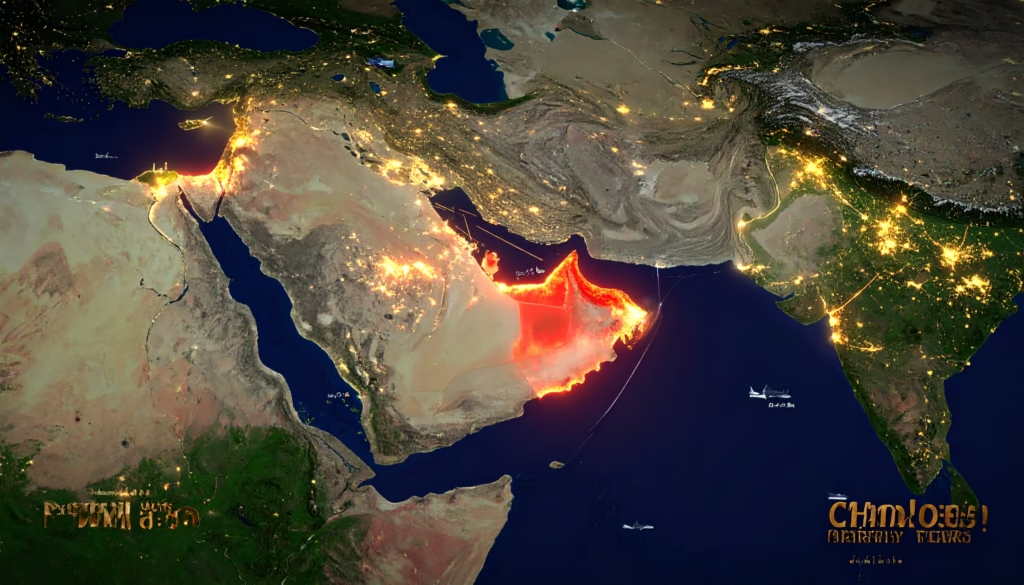
Global oil markets are experiencing a dramatic rally, with Brent crude prices surging past $115 per barrel as Yemen’s Houthi rebels, backed by Iran, escalate their involvement in the West Asia conflict. This widening war has ignited widespread fears of severe disruptions to key energy supply routes, pushing international benchmarks to multi-year highs amid heightened geopolitical tensions.
On Monday morning in early Asian trading sessions, Brent crude—the primary global oil benchmark—climbed nearly 3%, settling around $115.90 per barrel after touching an intraday peak of $116.75. Similarly, the U.S. West Texas Intermediate (WTI) crude benchmark leaped over 3% to exceed $103 per barrel. These sharp gains extend a multi-week uptrend driven by ongoing hostilities in the Middle East, now compounded by fresh Houthi threats.
Investors and traders are on high alert, as the Houthis’ missile strikes over the weekend targeted Israeli positions, with the group vowing sustained attacks until hostilities against Iran and its proxy militias end. This development layers additional risk onto oil markets already battered by prolonged regional instability.
Why Houthi Involvement is a Game-Changer for Oil Supply Chains
The Houthi movement, formally known as Ansar Allah, has a proven history of targeting critical energy infrastructure and shipping lanes. During previous flare-ups, such as the 2019-2020 Red Sea disruptions, Houthi drone and missile attacks forced major shipping firms to reroute vessels around the Cape of Good Hope, adding weeks to transit times and inflating freight costs by up to 40%.
-
Red Sea as a Vital Chokepoint: The Bab el-Mandeb Strait, linking the Red Sea to the Gulf of Aden, handles about 12% of global seaborne oil trade and 8% of liquefied natural gas (LNG). Houthi threats could once again paralyze this corridor, mirroring past incidents where oil tanker traffic dropped by 50%.
-
Proximity to Saudi Exports: Saudi Arabia’s Yanbu port on the Red Sea is a prime target, exporting up to 7 million barrels per day (bpd). Analysts warn that strikes here could slash Riyadh’s output by 20-30%, tightening global supplies already strained by OPEC+ production cuts.
-
Comparison to Strait of Hormuz: Often called the “crown jewel” of oil vulnerabilities, the Hormuz Strait funnels 21 million bpd—roughly 20% of world consumption. Houthi actions evoke fears of a “double blockade” scenario, akin to denying a patient life-saving surgery, as one expert likened it.
Mukesh Sahdev, CEO of XAnalysts Pty, captured the peril vividly: “Disrupting Yanbu is like blocking the emergency bypass when the main artery—Hormuz—is already clogged.” This analogy underscores how layered threats amplify risks beyond any single flashpoint.

Current Market Dynamics: Backwardation Signals Tight Supplies
Oil futures markets are flashing classic signs of imminent shortages. Brent’s structure has flipped into deep backwardation, where near-term contracts trade at a $7+ premium over later months—a bullish indicator seen in past crises like the 2022 Ukraine invasion.
Key market signals include:
-
Prompt Delivery Premiums: Front-month Brent at $115.90 vs. six-month contracts near $108, reflecting traders’ scramble for immediate barrels.
-
Inventory Draws: Global stockpiles have fallen 5% since conflict escalation began, per recent EIA data, with U.S. crude inventories dipping below five-year averages.
-
Refining Margins Surge: Crack spreads (the difference between crude and refined products) have widened to $25 per barrel, boosting profits but signaling feedstock scarcity.
These metrics suggest the oil price surge 2026 isn’t mere speculation; real supply constraints are emerging, exacerbated by Houthi attacks on oil supply routes.
Escalating Geopolitics: U.S. Buildup and Trump’s Bold Rhetoric
The conflict’s expansion draws in major powers, with the U.S. ramping up its regional footprint. Reports indicate thousands of additional troops deployed to bases in Qatar, Bahrain, and the UAE, as the Pentagon readies for potential prolonged engagements.
-
Ground Operation Speculation: The Washington Post highlighted preparations for Iran contingencies, though officials like Secretary of State Marco Rubio insist no invasion is planned.
-
Trump’s Oil Seizure Talk: In a Financial Times interview, President Donald Trump stoked volatility by floating U.S. control over Iran’s Kharg Island—the hub exporting 90% of Tehran’s 2.5 million bpd. Such a move could invite fierce Iranian retaliation, including mine-laying in Hormuz.
Iran’s response has been measured but ominous, with Revolutionary Guard commanders threatening asymmetric warfare. This rhetoric has widened the West Asia conflict oil impact, drawing parallels to the 1979 Iranian Revolution, when prices quadrupled.
Historical Context: Lessons from Past Middle East Oil Shocks
To grasp the stakes, consider oil’s volatile history tied to regional wars:
-
1973 Yom Kippur War: OPEC embargo spiked prices 400%, triggering global recession.
-
1990 Gulf War: Iraq’s Kuwait invasion sent Brent to $46 (over $100 inflation-adjusted).
-
2019 Abqaiq Attack: Houthi-claimed strikes on Saudi facilities cut 5.7 million bpd temporarily, lifting prices 15%.
Today’s scenario blends these risks: Houthi precision missiles, Iranian proxies, and U.S. deterrence. If Yanbu or Hormuz faces sustained hits, analysts project Brent could test $130-$150, per JPMorgan estimates.
Analyst Perspectives: Risk Premium vs. Actual Shock
While panic buying dominates, voices urge caution. Haris Khurshid, CIO at Karobaar Capital LP, notes: “This rally packs a hefty geopolitical risk premium—perhaps $10-15 per barrel—but absent direct hits on Gulf infrastructure, it’s volatility, not a paradigm shift.”
-
Bullish Views: Goldman Sachs sees $120 Brent as baseline if Red Sea traffic halves, citing low spare capacity (OPEC+ at 5 million bpd).
-
Bearish Counterpoints: IEA forecasts ample non-OPEC supply from U.S. shale (13 million bpd record) and Brazil, potentially capping gains unless war broadens.
-
Demand Factors: China’s post-pandemic recovery adds 1 million bpd demand, but EV growth and mild recession fears could temper upside.
According to Google data, search trends for “Brent crude price today” and “oil price forecast 2026” have increased 300% week over week, indicating the frenzy of retail investors.
Broader Economic Ripples: Inflation, Energy Costs, and Global Markets
A sustained oil price surge past $115 reverberates worldwide:
-
Inflation Pressures: Every $10/barrel rise adds 0.5% to U.S. CPI; Europe, reliant on imports, faces steeper hikes.
-
Stock Market Strain: Energy giants like ExxonMobil gain, but airlines (e.g., Delta down 4%) and consumers suffer.
-
India and Asia Impact: As India’s top oil importer, prices at ₹100/liter could fuel 7-8% inflation, hitting Kolkata’s transport and manufacturing sectors hard.
Renewable energy transitions offer long-term buffers, but short-term, fossil fuels remain kingpin.
What Lies Ahead: Scenarios for Oil Markets
Possible trajectories:
-
Containment: De-escalation via diplomacy keeps prices at $110-120.
-
Escalation: Houthi successes or Iranian reprisals push to $140+.
-
Supply Shock: Infrastructure hits trigger emergency releases from strategic reserves (U.S. SPR at 400 million barrels).
OPEC+ monitors closely, with potential output hikes from Saudi and UAE. Traders eye Wednesday’s EIA inventory report for clues.
In summary, the Houthi entry into West Asia conflict has supercharged oil prices, blending real supply fears with stratospheric risk premiums. As tensions simmer, energy markets hang in precarious balance—stay tuned for updates on this fluid crisis.
for more information visit BB