Yogini: Female Ascetic, Tantric Goddess, or Wild Erotic Witch?
Whether a yogini appears to you as a serene female counterpart to the meditating yogi or as an untamed, erotic sorceress depends entirely on the emotional weight you attach to four words: yogi, wild, erotic, and witch. For some, the word yogi conjures stillness, inner clarity, and the quiet grace of detachment. For others, it evokes rigid austerity—a brand of moralizing puritanism that treats sensuality and physical desire with suspicion, even disgust. Similarly, adjectives like wild, erotic, and witch either spark fascination or trigger deep cultural discomfort.
To understand the yogini in Indian spiritual history, one must look past modern anxieties and step into a world where the sacred was never neatly separated from the sensory, the fierce, or the feminine. Across Hindu, Buddhist, and Nath traditions, the yogini represents an ancient, unapologetic current of Indian spirituality—one that challenges narrow, sanitized definitions of faith and forces a confrontation with how society views female power.
Victorian Puritanism and the Sanitization of Indian Spirituality
A significant strand of modern Hindu thought exhibits a pronounced discomfort with sexuality. This prudishness is not an ancient, unbroken inheritance; rather, it is largely a colonial hangover forged in the nineteenth century. Under British rule, Victorian moralists frequently caricatured Indian religion and art—from temple sculptures to classical poetry—as decadent, overly sensuous, and morally lax. In response, generations of reformists and urban elites internalized Victorian shame. Eager to prove that Indian civilization was austere, disciplined, and intellectually respectable by European standards, they began scrubbing sensuality out of their own heritage.
This colonial-era conditioning taught many to view desire as an embarrassment and to deny women recognition as autonomous sexual beings. By filtering Indian traditions through frameworks borrowed from rigid, puritanical readings of Western Christianity or conservative Abrahamic moral codes, sex became equated with sin, the erotic became synonymous with evil, and untamed womanhood came to be seen as a threat requiring domestication. Within this narrowed lens, the Tantric dimensions of Hinduism—where the Divine Feminine stands at the absolute center of cosmic power—were pushed to the margins, dismissed as embarrassing relics rather than vital philosophical paths.
Tantra: Awakening Through the Body Rather Than Escaping It
For those willing to engage with the Divine Feminine without colonial shame, the yogini opens a gateway into Tantra—a profoundly distinct approach to spiritual wisdom. Classical Indian philosophy offers multiple avenues toward liberation and self-knowledge, each anchored in a different human faculty:
-
Mimamsa pursues cosmic order and fulfillment through precise sacred ritual and action.
-
Vedanta seeks ultimate truth through the intellect, philosophical discrimination, and contemplation of non-duality.
-
Bhakti dissolves the ego through the heart, cultivating intense emotional devotion and surrender to a personal deity.
-
Tantra charts a radically different course: it approaches awakening directly through the human body, embracing the full torrent of physical sensation—pleasure, pain, ecstasy, and even terror—as fuel for transformation.
Etymologically and conceptually, while mantra works primarily with the mind and subtle sound vibrations, tantra weaves spiritual realization through the corporeal frame (tan) and the living web of experience. Because this path deliberately engages taboo subjects, raw emotion, and somatic intensity, Tantric practitioners historically stayed outside the orthodox mainstream. Although the earliest surviving written Tantric treatises date back roughly 1,400 years, the underlying lineages are considerably older. Masters preferred secretive, face-to-face oral transmission from guru to initiate, deliberately encoding their teachings in symbolic twilight language (sandhya bhasha) to keep them out of the hands of the unprepared or the judgmental.
Reclaiming the “Witch”: Dayan, Dakini, and Forest Healers
Before examining the yogini’s role in temple art and scripture, it is worth unpacking the loaded label of “witch” and its colloquial South Asian counterpart, dayan. Both terms have been weaponized primarily against women, casting them as malevolent sorceresses who weave dark spells to trigger miscarriages, childhood illnesses, plagues, crop failure, infertility, and male impotence. Society dreaded their esoteric knowledge, yet paradoxically sought out their services whenever people wished to curse rivals or secure secret remedies.
Historically, however, the archetype of the witch likely originated in pre-Christian and pre-patriarchal folk traditions. These were often women deeply attuned to the natural world—herbalists, midwives, and healers who understood the medicinal and toxic properties of roots, plants, and minerals. Viewing the forest itself as a living Goddess, they aligned their lives with nature’s cycles of birth, decay, and renewal. Crucially, many lived on the fringes of settled villages, either in solitude or in female-centered communities, rejecting the confines of conventional marriage and engaging with men strictly on their own terms as companions, lovers, or aides. Mainstream patriarchal society regarded these independent forest women with a volatile mix of reverence and dread.

Linguistically, the Hindi word dayan is widely traced to dakini or dankuni—terms rooted in folk Hindu and Tantric Buddhist lore that describe fierce, sky-going, forest-dwelling goddesses who are simultaneously sensual and violent. Unlike domesticated, gentle consort goddesses who embody social harmony, dakinis represent untamed cosmic energy. The friction between these autonomous feminine figures and orthodox society proved deadly across cultures. In Europe, the rise of institutional Christianity culminated in centuries of systematic witch trials and executions. In parts of rural India, the shadow of this fear persists to this day, with women—frequently widows, Dalit women, or those owning disputed land—still brutally targeted and murdered under accusations of witchcraft.
Similar anxieties echo across global folklore. In parts of the Islamic world, feared female spirits were linked to dangerous djinn. Victorian Europe obsessed over tales of succubi—seductive night spirits accused of draining men of their vitality. In Kerala, regional legends speak of the yakshini, a mesmerizing, supernatural forest woman who lures travelers with beauty and peril alike. Whether the yakshini was simply a regional manifestation of the yogini remains a matter of historical speculation, yet the shared cultural blueprint is unmistakable: a powerful, unowned woman who commands both desire and terror.
Yogi Versus Yogini: Transcending Nature Versus Celebrating It
A common misconception treats “yogini” as nothing more than the grammatical feminine form of “yogi.” Yet Hindu, Buddhist, and Nath traditions reveal a striking philosophical divergence between the two figures. The classical male yogi typically pursues liberation by withdrawing from both human society (sanskriti) and the material world of nature (prakriti). Through celibacy, breath control, and sensory withdrawal, he aims to transcend the body and escape the cycle of biological existence.
The yogini, by contrast, embodies and celebrates nature in all its ferocious splendor. Rather than fleeing the rhythms of blood, fertility, decay, and desire, she stands squarely within them. Her spiritual power does not arise from suppressing the physical world, but from mastering and channeling its rawest currents.
Vajrayogini and the Fierce Iconography of Tantric Buddhism
Nowhere is this untamed spiritual power more vividly expressed than in Vajrayana (Tantric) Buddhism, particularly through the figure of Vajrayogini. Revered as a fully enlightened female Buddha, Vajrayogini shatters every polite stereotype of passive femininity. Traditional iconography depicts her as blazing, dynamic, and fiercely uninhibited—standing in a wide, commanding posture, often trampling corpses that symbolize the ego and illusion.
Notice the unmistakable visual vocabulary in traditional sculptures of Vajrayogini: the garland of severed heads, the carved bone apron, and the athletic, unapologetic stance atop a lotus pedestal. In painting and statuary, she routinely wields a curved flaying knife (kartika) in one hand to sever attachment and holds a skull cup (kapala) brimming with blood in the other to signify the transformation of mortal impurity into blissful wisdom. In Tibetan Buddhist art, female Tantric deities also appear in Yab-Yum (“father-mother”) iconography, seated in explicit sexual union atop a male Bodhisattva.
Scholars and practitioners have debated the precise meaning of such imagery for centuries:
-
Metaphorical union: Many lineages interpret Yab-Yum as a visual philosophy depicting the inseparable union of skillful means and compassion with transcendent wisdom—two polarities required for enlightenment.
-
Esoteric physiology: Other traditions point to advanced Tantric practices involving subtle-body yogic techniques aimed at redirecting sexual energy and drawing vital fluids upward along the central spinal channel.
-
Cross-tradition pollination: If Vajrayogini’s imagery immediately recalls the Hindu goddess Kali—who likewise wears a garland of skulls, wields blades, and dances on the prostrate body of Shiva—the resemblance is no coincidence. Tantric Buddhism and Hindu Shiva-Shakti lineages evolved side by side in medieval India, exchanging rituals, deities, and esoteric philosophies across centuries.
The Open-Air Temples of the 64 Yoginis (Chausath Yogini)
In Hindu architectural history, the veneration of yoginis reached a remarkable peak between the ninth and eleventh centuries, when patrons commissioned dedicated shrines to the collective of Chausath (64) Yoginis. Among the most celebrated surviving examples are four extraordinary temples: two in Odisha (at Hirapur and Ranipur-Jharial) and two in Madhya Pradesh (at Khajuraho and Bhedaghat).
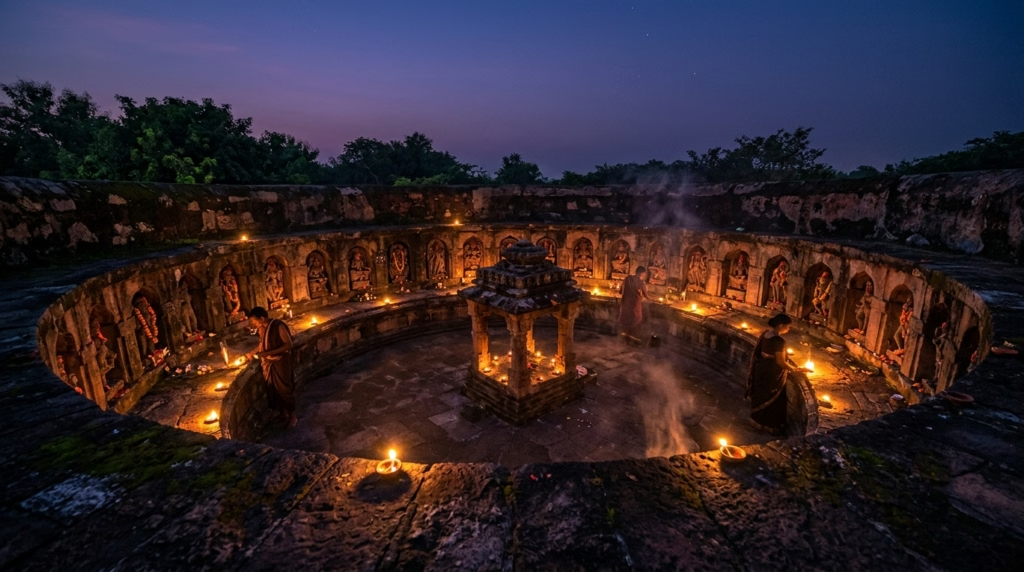
Unlike conventional Hindu temples—which feature towering spires (shikharas) enclosing a dark, roofed inner sanctum (garbhagriha)—Chausath Yogini temples are typically circular and hypaethral (completely open to the sky). Along the curved interior perimeter wall, niches house stone sculptures of the sixty-four yoginis, all facing inward toward a central shrine or pavilion.
The Hirapur temple in Odisha, seen above, exemplifies this intimate, al fresco design. Its low circular sandstone enclosure lacks any roof, allowing sunlight, moonlight, and rain to pour directly onto the courtyard where devotees stood surrounded by the inward gaze of the goddesses. Across the major surviving sites, each temple showcases a distinct artistic mood:
| Chausath Yogini Temple | State | Architectural & Iconographic Highlights |
| Hirapur | Odisha | Compact circular stone enclosure; yoginis carved in dark chlorite, standing gracefully on diverse animal mounts (vahanas). |
| Ranipur-Jharial | Odisha | Large open-air circular sandstone shrine; yoginis depicted in dynamic, rhythmic dancing postures around a central Shiva-Bhairava pavilion. |
| Bhedaghat | Madhya Pradesh | Expansive hilltop circular cloister overlooking the Narmada River; yoginis carved predominantly in seated, regal postures with inscribed names. |
| Khajuraho | Madhya Pradesh | Rare rectangular open-air plan built of coarse granite; the oldest surviving temple in the Khajuraho monument group. |
What makes the Chausath Yogini pantheon truly revolutionary is its refusal to reduce womanhood to a single idealized mold. The inscribed names and carved forms encompass the entire spectrum of female existence:
-
Female counterparts of major gods: Shaktis such as Aindri, Varahi, and Vaishnavi, who wield the cosmic authority of Indra, Varaha, and Vishnu.
-
Fierce independent goddesses: Autonomous deities like Kali and Chhinnamasta, who answer to no male consort.
-
Benevolent and malevolent aspects: Auspicious figures like Lakshmi placed right alongside terrifying, wrathful, or grotesque forms such as Birupa.
-
Every stage of beauty and age: Some yoginis are sculpted as youthful, voluptuous, and alluring; others are skeletal, wrinkled, animal-headed, or deliberately unsettling.
Nothing deemed “unacceptable” by polite society is excluded. In modern times, however, this sweeping celebration of feminine multiplicity has been largely eclipsed by an overwhelming cultural preference for celibate male ascetics who define holiness through the rejection of all things feminine.
Nath Folklore: Celibate Siddhas and the Power of Marginalized Women
The tension between male asceticism and female Tantric power plays out vividly in the medieval folklore of the Nath Sampradaya, an influential Shaiva yogic order. In Nath narratives, yoginis are frequently portrayed not as distant celestial beings, but as flesh-and-blood women wielding formidable occult powers. Strikingly, these legends often identify yoginis as women from historically marginalized or “lower” caste artisan and service communities—washerwomen, potters, weavers, and attendants of cremation grounds.
Throughout Nath storytelling, these women lock horns with celibate male monks (siddhas) who derive their miraculous abilities from strict sexual restraint. Two legendary episodes capture this friction:
-
The Rescue of Matsyendranath: According to popular Nath lore, the great teacher Matsyendranath became enchanted by a kingdom ruled entirely by women (often identified as Kadali Desha). Captivated by sensual pleasure and feminine magic, he abandoned his ascetic vows until his fiercely celibate disciple, Gorakhnath, infiltrated the realm in disguise and woke his guru from his trance, pulling him back to the path of renunciation.
-
Jalandharnath and the Donkeys: Another cycle of tales recounts a magical clash between the siddha Jalandharnath and a band of yoginis who outwit his disciples and transform them into donkeys—a motif remarkably reminiscent of the enchantress Circe turning Odysseus’s crew into swine in Homer’s Odyssey.
How should modern readers interpret these narratives? Were they echoes of real historical rivalries between competing Tantric sects? Were they psychological projections of a patriarchal society deeply uneasy with women who refused subservience? Or were they mythic allegories dramatizing the eternal spiritual friction between male celibacy and female sexuality? Because these tales traveled orally for generations, we can only speculate—yet their survival confirms how central female spiritual power once was to the Indian imagination.

Modern Gatekeeping and the Vastness of Hinduism
Despite centuries of stone temples, scriptures, and living folklore, a vocal segment of contemporary society—often comprising urban, upper-caste men educated in technical fields and eager to project a globally palatable, Western-aligned image of India—insists that Tantric yogini traditions are either fabrications or corruptions outside “pure” Hinduism. This defensiveness frequently boils over into hostility whenever female scholars, historians, and anthropologists bring these texts and sculptures into public conversation. Unseating puritanical gatekeepers from their moral pedestals provokes the same reactionary anger visible across modern online spaces whenever strong, independent women challenge patriarchal norms.
Yet the stone walls of Hirapur and Bhedaghat cannot be erased by modern discomfort. The yogini stands as enduring proof that Hinduism is vast, pluralistic, and gloriously heterogeneous—never the exclusive property of puritanical priests or celibate male hermits. She embodies the wild, creative, terrifying, and compassionate pulse of existence itself. Recognizing the yogini as a rightful, unapologetic face of Bharat Mata does not require anyone’s permission; it merely requires the courage to see India’s spiritual heritage in its full, untamed richness.
for more analysis visit BB daily.