Why Is the Moon Drifting Away from Earth? Unpacking the Cosmic Shift
Imagine gazing at the night sky, where the Moon has hung like a faithful companion for eons. Yet, astonishingly, it’s not staying put. The Moon is gradually drifting away from Earth at a rate of about 3.8 centimeters per year—a subtle cosmic migration confirmed by precise laser ranging experiments since the Apollo era. This isn’t science fiction; it’s a measurable reality detailed in recent analyses from sources like The Conversation, highlighting how this slow separation reshapes our planet’s tides, rotation, and long-term destiny.
For curious minds searching “Moon drifting away from Earth facts,” this phenomenon stems from gravitational interplay. Earth’s oceans bulge due to lunar pull, creating tides that dissipate energy as friction. This energy transfer propels the Moon into a wider orbit, while Earth’s spin gradually decelerates. Over geological timescales, these tiny shifts add up, influencing everything from ancient ecosystems to humanity’s far-future survival.
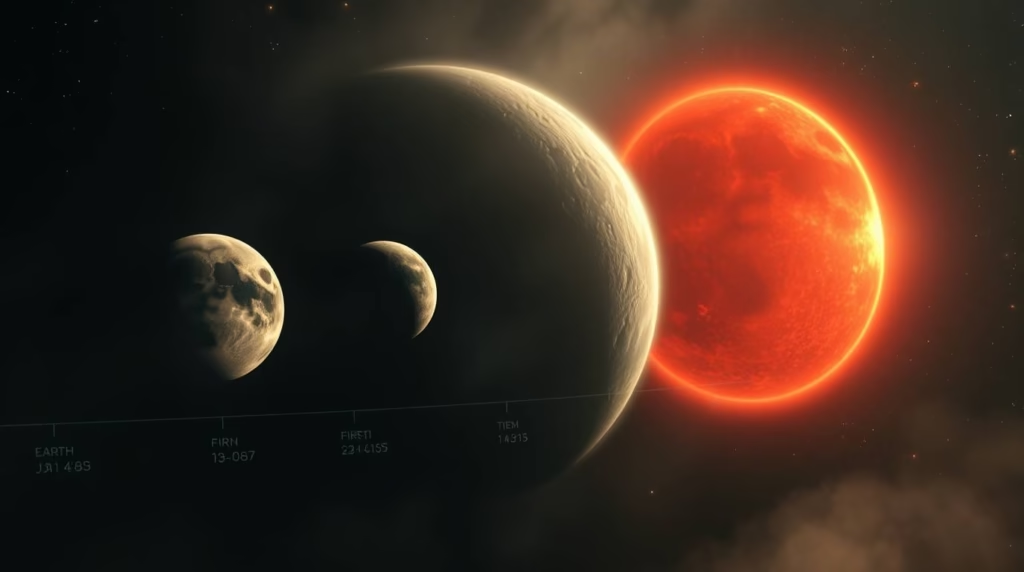
The Science Behind the Moon’s Orbital Migration
Scientists track the Moon’s recession using retroreflectors—mirror arrays left by Apollo 11, 14, and 15 astronauts. Lasers fired from Earth bounce back, revealing the lunar distance with millimeter accuracy. Data spanning over 50 years shows consistent drift: from 384,400 kilometers today, it’s widened by about 3.8 cm annually.
This process, known as tidal acceleration, follows conservation of angular momentum. Here’s how it works in simple terms:
-
Tidal Bulges: The Moon’s gravity creates two high tides on Earth, slightly ahead of its position due to our planet’s rotation.
-
Gravitational Drag: Earth’s faster spin drags these bulges forward, pulling the Moon ahead and expanding its orbit.
-
Energy Trade-Off: The Moon gains orbital energy (speeding up slightly in its path), while Earth loses rotational energy, lengthening days.
Keywords like “Earth-Moon tidal friction” capture this dynamic. Without the Moon, Earth’s rotation would be chaotic, but this dance stabilizes our world—yet it’s evolving.
Earth’s Rotation Slowing: From Dinosaur Days to Tomorrow
One of the most profound effects of the Moon drifting away is Earth’s decelerating spin. Each century, days lengthen by about 2.3 milliseconds. In the Cretaceous period, when dinosaurs roamed, a day lasted around 23 hours. Fast-forward to now: 24 hours. Project millions of years ahead, and it could hit 25 hours.
This ties directly to “Earth rotation slowing causes.” Tidal friction converts rotational kinetic energy into heat, dissipated in oceans and seafloors. Evidence abounds in coral growth rings and bivalve shells, which act like ancient clocks, revealing shorter days in the distant past.
Bullet-point timeline of day length evolution:
-
~620 million years ago (Ediacaran): ~21.9-hour days, per fossil records.
-
~400 million years ago (Devonian): ~22.5 hours.
-
Jurassic (~150 million years ago): ~23 hours.
-
Present: 24 hours.
-
1 billion years future: Potentially 25-27 hours.
Such changes disrupt ecosystems, from marine migrations synced to daylight to human societies reliant on 24-hour clocks. As searches for “future Earth day length” rise, understanding this prepares us for subtle shifts in agriculture, energy, and biology.
Echoes from the Past: When the Moon Orbited Closer
Delve into “Moon’s ancient distance from Earth,” and geological treasures like tidal rhythmites—layered sediments from ancient shorelines—reveal a tighter embrace. Around 2.5 billion years ago, the Moon sat just 200,000-250,000 km away, rising huge in the sky and unleashing tides up to 10 meters higher than today.
These mega-tides sculpted coastlines, mixed ocean nutrients, and possibly sparked life’s origins by concentrating chemicals in tidal pools. Stromatolites, Earth’s oldest fossils, hint at how intense tidal cycles influenced early microbes.
Modern models refine this history:
-
Continental drift altered ocean basin shapes, changing tidal resonance.
-
Supercontinents like Rodinia amplified or damped tides, nudging the Moon’s path.
-
Glacial epochs locked ocean water on land, weakening tidal drag temporarily.
This “intimate cosmic relationship” proves the Earth-Moon system is dynamic, not fixed—a living archive etched in rocks.
Future Horizons: Tidal Locking and Lengthening Days
Peer billions of years into “Moon drifting away future implications,” and the picture transforms. As the Moon recedes to perhaps 600,000 km, Earth’s rotation crawls to match one lunar month—about 47 current days per rotation. Tidal locking emerges: one hemisphere forever daytime-facing the Moon, the other in perpetual night.
Visualize it:
| Epoch | Moon Distance (km) | Earth Day Length | Key Effect |
|---|---|---|---|
| Present | 384,000 | 24 hours | Stable tides |
| 1 Billion Years | ~450,000 | ~25 hours | Weaker tides, climate shifts |
| 2-3 Billion Years | ~550,000 | ~35-40 hours | Extreme day-night cycles |
| Tidal Lock (~50 Billion Years, theoretical) | ~1,000,000+ | = Lunar Month | Permanent lunar view on one side |
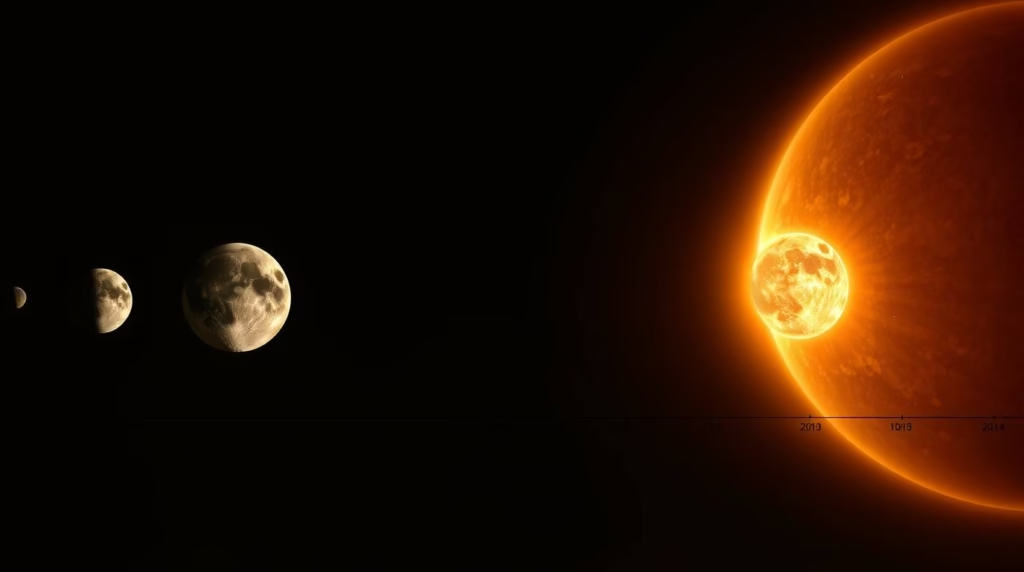
Before locking, tides weaken dramatically. Coastal erosion slows, mangroves and wetlands shrink, and ocean currents like the Gulf Stream falter, potentially cooling climates. Marine life adapts or perishes; human tech might engineer artificial tides via mega-structures.
Yet, cosmic drama intervenes. In 5-7 billion years, the Sun balloons into a red giant, swelling to Earth’s orbit. The Moon’s widened path might evade engulfment, dragging Earth outward via residual gravity—or destabilize into solar system chaos. Queries on “tidal locking Earth Moon” underscore this as a slow-burn apocalypse, not sudden doom.
Broader Impacts: Tides, Life, and Solar System Stability
Beyond rotation, the Moon’s drift ripples through Earth’s habitability. Stronger past tides oxygenated oceans, fostering complex life. Future fading tides could stagnate seas, harming biodiversity.
Stabilization role: The Moon prevents extreme axial wobbles, maintaining seasons. A receding Moon risks polar wander, altering ice caps and sea levels.
Solar system-wise, this evolution influences neighbors. Jupiter’s moons exhibit similar drifts, hinting at universal processes. For “Earth-Moon system implications,” it’s a microcosm of gravitational artistry.
Humanity’s response? Space agencies eye lunar bases before tides weaken launch windows. AI simulations predict trajectories, aiding “long-term Earth future” forecasts.
Why This Matters Now: Lessons from Cosmic Patience
The Moon drifting away reminds us of impermanence. At 3.8 cm/year, it’s imperceptible in lifetimes but monumental over eons. It drives curiosity in “why Moon receding from Earth,” fueling education, VR simulations, and astrobiology.
Protecting this system means tackling climate change, which modulates modern tides via sea-level rise.
In summary—not conclusion, but forward gaze—this drift heralds a slower, tidally locked Earth, shadowed by solar evolution. Track it via apps or observatories; our satellite’s journey shapes tomorrow’s world.
read more articles. visit BB daily.