Botanical Sexism and the Urban Canopy: How Municipal Tree Policies Shape the Air City Residents Breathe
For decades, city planners favored male street trees to keep sidewalks free of messy fruit and pungent seeds. New scientific findings reveal a far more complex relationship between urban forestry, feral trees, and worsening seasonal allergies.
Every autumn, the broad fan-shaped leaves of Ginkgo biloba turn a luminous gold along city avenues across North America. Yet during the fall of 2017, Ned Friedman, an evolutionary botanist at Harvard University’s Arnold Arboretum, drew a crowd beneath a female ginkgo near Boston’s Walter Street gate for a lesson that had little to do with foliage. Littering the ground around the trunk were fleshy, fallen seeds emitting a sharp, unmistakable stench. Their outer coats contain butyric acid—the exact chemical compound responsible for the odor of spoiled butter and human vomit. Friedman invited visitors to experience this pungent botanical reality firsthand, offering an unvarnished encounter with plant evolution that no textbook photograph could replicate.
Just a few hundred miles south, municipal planners in New York City had long chosen to keep that sensory experience off public pavements. In the city’s official street-tree planting guidelines, the ginkgo carries an unambiguous two-word restriction: “Male Only.” Male ginkgoes cast the same resilient shade and display the same autumn brilliance without dropping foul-smelling seeds onto busy sidewalks. Commercial nurseries cater directly to this municipal demand, grafting cloned male cultivars—most notably Autumn Gold—years before a sapling ever reaches a curbside tree pit.
On the surface, favoring male street trees looks like sensible civic housekeeping. Sidewalks stay clean, maintenance crews sweep up less organic debris, and pedestrians avoid tracking crushed fruit into buildings. Over the past two decades, however, that tidy urban-planning consensus has collided with a mounting public health concern. As spring allergy seasons grow longer and more punishing across major metropolitan areas, scientists, horticulturists, and public health officials have begun asking an urgent question: did a century of prioritizing clean pavement inadvertently fill urban air with higher concentrations of allergenic pollen?
How the Quest for Clean Sidewalks Sparked “Botanical Sexism“
The municipal habit of selecting trees by sex predates modern allergy research by generations. In its 1949 Yearbook of Agriculture, the U.S. Department of Agriculture formally advised communities across the Great Plains to plant male cottonwoods along residential streets. The agency’s rationale centered on nuisance control: female cottonwoods shed vast drifts of white, cottony seeds that clogged window screens, blanketed lawns, and drew complaints from residents. Many homeowners mistakenly blamed those visible white fluffs for their sneezing fits. In reality, the allergy-triggering pollen had drifted invisibly through the air weeks earlier—released exclusively by male trees. Because swept-up litter demanded immediate municipal labor while microscopic pollen went unseen, the visible mess dictated planting policy.
Nursery breeders applied the exact same calculus to other popular shade trees. Consider the white mulberry (Morus alba), a fast-growing species prized for thriving in compacted urban soils. Female mulberries drop heavy crops of dark berries that permanently stain concrete walkways and parked vehicles. To solve the aesthetic headache, growers cultivated and marketed an all-male variety named “Fruitless.” The trees delivered on their promise of spotless sidewalks, yet every spring they compensated by discharging dense clouds of wind-borne pollen into surrounding neighborhoods.
For Thomas Leo Ogren, a horticulture educator in California, this widespread preference for male ornamentals ceased to be an abstract forestry trend when his wife, Yvonne, struggled with severe asthma and seasonal allergies. Determined to trace the source of local triggers, Ogren began walking neighborhoods with a camera to document the blossoms of common street trees and landscape shrubs. Time and again, his lens captured male flowers loaded with pollen, while female blooms proved remarkably difficult to locate.
In 2005, Ogren coined the term “botanical sexism” to characterize this systematic municipal bias. His argument was straightforward and resonant: by banishing seed- and fruit-bearing female trees from city streets, urban planners were trading ground-level litter for airborne irritants. Ogren also highlighted an overlooked ecological dynamic. In balanced natural forests, female flowers act as biological scrubbers, capturing drifting pollen grains out of the breeze to complete fertilization. When an urban corridor consists almost entirely of male clones, pollen grains have nowhere to land. They remain suspended in city air longer, swirling around pedestrians at breathing height and turning shaded avenues into seasonal allergy traps.
Long before Ogren gave the phenomenon a memorable name, at least one rapidly expanding American metropolis treated tree pollen as a regulated air pollutant. In 1991, officials in Clark County, Nevada—home to the Las Vegas metropolitan region—enacted a strict ordinance prohibiting both the commercial sale and new planting of fruitless mulberry and European olive trees. Local air-quality monitors had linked both species directly to severe springtime pollen spikes across the desert basin.
Under the county’s enforcement framework, nurseries seeking permission to market low-pollen cultivars must scientifically prove that their trees emit less than 15 percent of the pollen produced by mature standard specimens. That landmark rule established an enduring legal precedent: municipal tree selection is not merely a landscaping choice, but a direct lever of urban air-quality management.
What New York City’s Air Samplers Actually Found
“Botanical sexism” quickly gained traction in environmental journalism and public conversation, offering an intuitive explanation for miserable spring mornings. Yet scientific researchers wanted hard empirical measurements. In a sprawling, ecologically diverse city like New York, how much of the airborne pollen burden actually originates from “male-only” street-tree policies?
The groundwork for answering that question began in 2009, when Guy Robinson, a researcher at Fordham University, mounted a volumetric pollen sampler on the roof of the university’s law school in Manhattan. At ground level, local high school students fanned out across nearby blocks to identify and map the surrounding tree canopy. Years later, Daniel Katz joined Robinson and a broader team of researchers to merge four full seasons of rooftop pollen measurements with comprehensive citywide tree inventories and species-specific pollen production models.
Published in 2024 in collaboration with the U.S. Forest Service, their findings complicated the prevailing narrative about single-sex planting. The data demonstrated that while municipal tree policies undeniably shape urban pollen, the biggest culprits in New York’s spring air were not male street ginkgoes at all.
| Tree Species / Group | Reproductive Biology | Urban Planting Status | Share of Captured Pollen (Manhattan) | Key Ecological & Air-Quality Takeaway |
|---|---|---|---|---|
| Ginkgo (Ginkgo biloba) | Dioecious (separate male and female trees) | Strictly “Male Only” along city streets | Less than 1.0% | Avoids foul-smelling fallen seeds while contributing a negligible fraction of total airborne pollen. |
| White Mulberry (Morus alba) | Dioecious (separate male and female trees) | Mostly unplanted feral growth (only 2 of 9 trees planted) | Nearly 25.0% | Major allergenic driver fueled primarily by wild urban colonization rather than city planting mandates. |
| London Plane (Platanus × acerifolia) | Monoecious (male and female flowers on one tree) | Extensively planted historically for shade and durability | Major share of the 71% multi-species pool | Top estimated single-species pollen producer citywide due to vast canopy size and abundance. |
| Oak & Birch (Quercus & Betula spp.) | Monoecious (male and female flowers on one tree) | Broadly planted and naturally occurring urban canopy | Major share of the 71% multi-species pool | Ecologically vital species generating heavy seasonal pollen independent of sex-selective forestry. |
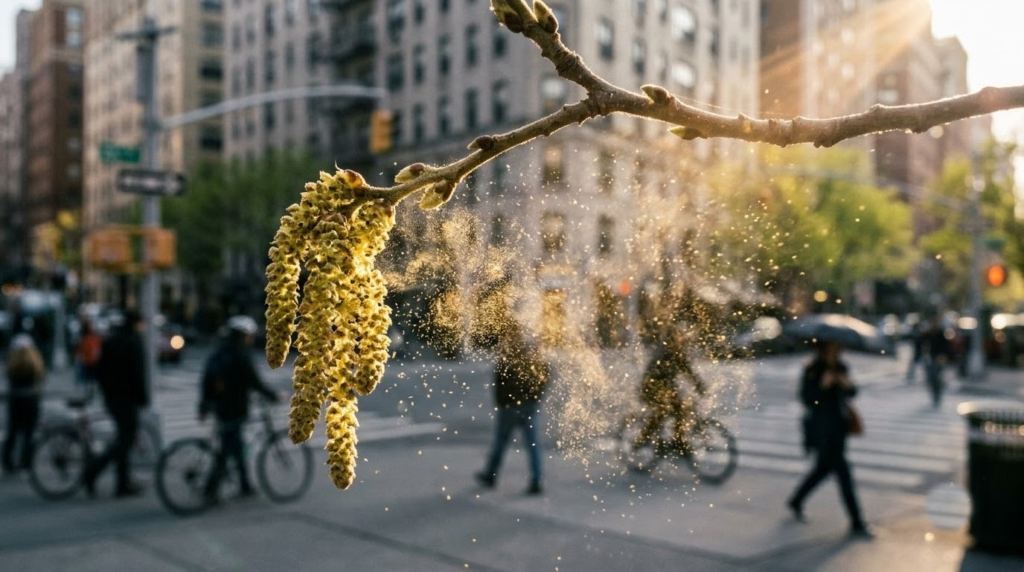
Despite New York City’s strict insistence on planting male ginkgoes, Ginkgo biloba accounted for less than one percent of all pollen collected at the Manhattan monitoring station. Instead, just four groups—oak, London plane, mulberry, and birch—combined to generate 71 percent of the total sample. Nearly one-quarter of the entire pollen load came from white mulberry alone.
At first glance, that heavy mulberry spike might seem like direct confirmation of Ogren’s thesis. Closer inspection of the city’s tree surveys, however, revealed a striking surprise: only two out of every nine white mulberries growing across New York had been intentionally planted by humans. The overwhelming majority were feral volunteers—hardy trees that had sprouted spontaneously along chain-link fences, railway embankments, alleyways, and neglected vacant lots. While selecting a male sapling certainly influences conditions on a single sidewalk, municipal nursery orders cannot account for a citywide mulberry plume propelled by unmanaged wild growth.
Where deliberate civic planting did leave an unmistakable signature in the air was in the London plane (Platanus × acerifolia). For generations, New York parks officials prized this hybrid sycamore for its sweeping crown and extraordinary tolerance for automotive exhaust, road salt, and tight sidewalk pits. That institutional loyalty endures today; when Grand Army Plaza South underwent a major restoration in 2026, planners deliberately reestablished its historic double rows of London planes. According to the 2024 modeling study, the London plane ranks as the single largest estimated pollen producer among all individual tree species in the five boroughs.
Crucially, however, the London plane is monoecious, bearing both male and female flowers on the same individual tree. Its massive contribution to spring pollen stems not from single-sex nursery selection, but from sheer population density, physical stature, and decades of over-reliance on a single resilient species. The same holds true for native and widely planted oaks and birches, whose substantial seasonal output occurs entirely independent of sex-based planting rules.
Street-Level Microclimates: Why Rooftop Pollen Counts Miss Half the Story
While the Manhattan rooftop station provided a vital panoramic view of regional airborne allergens, researchers recognized a critical blind spot: people do not commute on rooftops. Pollen concentrations at street level—where commuters wait for buses, children walk to school, and joggers pass directly under flowering canopies—can diverge dramatically from readings taken several stories above ground.
To map those ground-level disparities, researchers conducted a separate field investigation during the 2013 spring season, strapping pollen traps directly onto utility poles across all five New York City boroughs. Forty-four monitoring sites yielded usable seasonal datasets, exposing stark neighborhood-by-neighborhood microclimates that citywide averages completely obscure.
For London plane trees, measured pollen concentrations varied by a staggering seventyfold between the lowest-exposure open zones and the highest-exposure residential corridors. City dwellers living on narrow blocks lined continuously with mature plane trees inhaled intensely concentrated plumes every morning, whereas residents just neighborhoods away in more open or botanically diverse areas encountered only minimal levels. Those street-level findings carry serious implications for urban health equity: daily allergy risk depends heavily on which specific species happen to tower directly outside a resident’s apartment window.
Biological Surprises and the Future of the Urban Canopy
Even when municipalities commit wholeheartedly to cloning and planting exclusively male trees, nature does not always comply with the nursery tag. Botanists have long known that certain dioecious species exhibit remarkable reproductive plasticity, occasionally shifting sex in response to age, stress, or shifting environmental conditions.
A vivid demonstration of that biological unpredictability unfolded at Portland’s Hoyt Arboretum in Oregon. An Autumn Gold ginkgo—a cultivar specifically propagated and sold as a strictly male clone—began producing fleshy seeds on its own. Before long, a second tree in the same arboretum grove followed suit. Rather than treating the unexpected crop as a nuisance to be swept into landfills, arboretum staff teamed up with volunteers from the Portland Fruit Tree Project in the fall of 2025 for a community harvest.
Nursery specialist Brett Rousseau described gently shaking the tree’s branches and gathering the fallen golden seeds by hand from the carpet of yellow leaves below. Working together, the volunteers collected 77 pounds—roughly 35 kilograms—of fleshy seeds from the two trees, carefully packing their haul into reused strawberry boxes. Once the pungent outer coats were cleaned and processed, the inner ginkgo nuts were donated to the Asian Food Pantry at the Center for Positive Aging, where the nuts are cherished as a traditional culinary delicacy. Looking at the stacked boxes of freshly harvested produce, Rousseau noted that he could easily envision ginkgo nuts eventually appearing alongside everyday fruits and vegetables on local grocery shelves.
Packing the harvest into strawberry crates did nothing to mask the unmistakable bite of butyric acid, yet the Portland effort reframed a supposed urban nuisance into a meaningful civic resource. More broadly, it underscored a vital truth for twenty-first-century urban forestry: trees are living, adaptive organisms that continue interacting with soil, climate, and human communities long after leaving a commercial nursery.
As cities expand their tree canopies to combat extreme urban heat islands and manage stormwater runoff, the debate over botanical sexism offers an essential corrective. Solving urban allergy burdens will not come from swapping out one street tree sex for another, nor from stripping cities of vital shade. Instead, the evidence from Boston, Las Vegas, New York, and Portland points toward deeper ecological diversification—limiting monoculture planting of heavy pollen emitters like London planes, monitoring feral species in neglected corridors, integrating low-pollen varieties where appropriate, and designing urban forests around biological balance rather than cosmetic sidewalk perfection.