Unraveling the Mystery: Where Did Earth’s Water Really Come From?
The question “where did Earth’s water come from?” has puzzled scientists for generations. Our planet’s vast oceans cover 71% of its surface, holding about 1.4 billion cubic kilometers of water—essential for life as we know it. For years, one leading hypothesis pointed to a cosmic delivery service: water-rich meteorites and comets bombarding Earth during its chaotic early days. But recent discoveries from an unlikely source—the Moon—are flipping this narrative upside down. Hidden clues in lunar soil suggest these space rocks contributed far less than we thought, prompting a rethink of Earth’s watery origins.
This revelation comes from cutting-edge analysis of samples brought back by NASA’s Apollo astronauts over 50 years ago. Far from being relics, these moon rocks are rewriting planetary science. In this article, we’ll dive into the evidence, explore the science behind it, and consider what it means for future missions like Artemis. If you’ve ever wondered about the “origin of Earth’s water” or the role of the “Moon in Earth’s water history,” read on for a comprehensive breakdown.
The Moon as Earth’s Ancient Recorder
Imagine the Moon as a giant, dusty scrapbook of the solar system’s turbulent youth. While Earth is a dynamic world—its surface constantly reshaped by plate tectonics, volcanoes, and erosion—the Moon lacks these processes. Its airless, unchanging surface, called regolith, acts like a pristine archive, trapping debris from every asteroid, comet, and meteorite that has slammed into it over billions of years.
This regolith—a fine, powdery layer up to 15 meters thick in places—preserves “chemical fingerprints” from ancient impacts. Earth, by contrast, has erased much of its own history through recycling. By studying the Moon’s soil, scientists gain a clearer window into the materials that also pelted our planet around 4 billion years ago, during the Late Heavy Bombardment—a period of intense meteorite rain.
NASA researchers, leveraging Apollo samples, have now quantified this debris. Their findings? The meteorites that delivered water weren’t the ocean-fillers we imagined. This challenges the “water-rich meteorite theory” and opens doors to alternatives, like water locked in Earth’s mantle from its formation or delivered by vaporized comets.
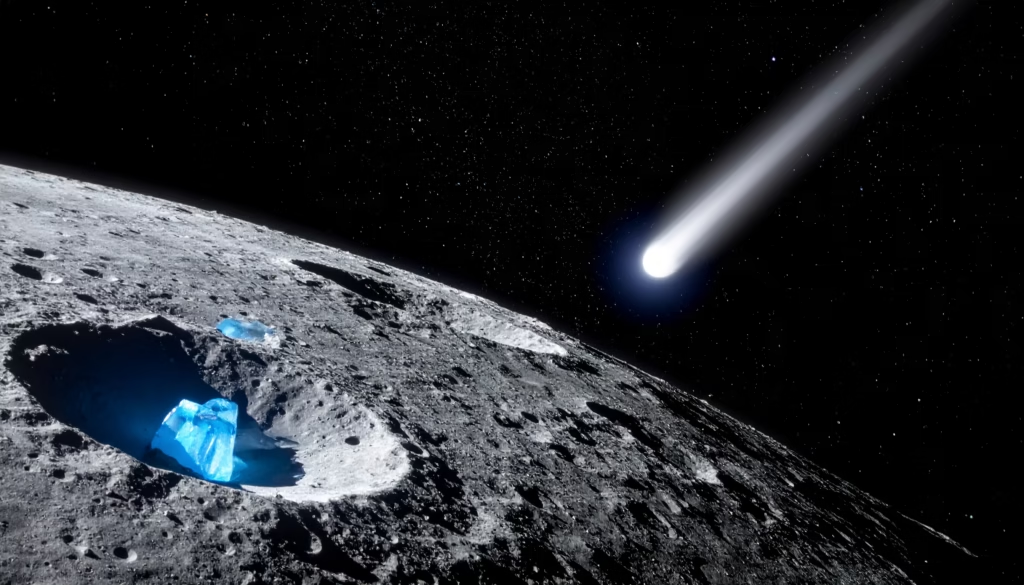
Breakthrough Science: Triple Oxygen Isotopes Unlock the Secrets
At the heart of this discovery is a high-tech detective technique: analyzing triple oxygen isotopes. Oxygen, making up nearly half the mass of rocks, comes in variants (isotopes) like oxygen-16, oxygen-17, and oxygen-18, each with a different number of neutrons. These ratios form unique signatures, stable even when a meteorite explodes on impact, mixing with lunar soil.
Led by experts at NASA’s Johnson Space Center, including key figures like Tony Gargano, the team developed a precise method to measure all three isotopes simultaneously. Published in the prestigious Proceedings of the National Academy of Sciences (PNAS), their study examined Apollo regolith samples. What they found was eye-opening: only about 1% of the lunar soil comes from carbonaceous chondrites—primitive, carbon-rich meteorites known for carrying water bound in minerals like serpentine.
To put this in perspective, carbonaceous chondrites can hold up to 10-20% water by weight. But even scaling this up to Earth’s size and the bombardment era, the total water delivered falls short. Calculations show these meteorites could account for just 1-5% of Earth’s ocean volume—nowhere near enough to fill our seas. It’s like trying to fill an Olympic swimming pool with a garden hose over eons; the math simply doesn’t add up.
This isotope “fingerprinting” isn’t new—it’s been used to distinguish meteorite types—but applying it to lunar regolith for water delivery estimates is groundbreaking. It debunks the idea of a “meteorite deluge” as the primary source, shifting focus to Earth’s internal water reservoirs or earlier, vaporized deliveries.
Why the Numbers Don’t Add Up for Earth’s Oceans
Let’s break down the math behind this revelation. Earth’s hydrosphere totals around 1.386×10⁹ cubic kilometers of water. Carbonaceous chondrites, the wettest variety, delivered material equivalent to perhaps 0.1-1% of the Moon’s regolith over 4 billion years.
Extrapolating to Earth (about 81 times the Moon’s mass), generous models predict a maximum contribution of 1021 to 1022 kilograms of water—still only a fraction (less than 10%) of what’s needed. Earlier comets might have added more, but their deuterium-to-hydrogen ratios don’t perfectly match Earth’s oceans, suggesting they vaporized and escaped.
Instead, emerging theories propose:
-
Primordial water: Hydrated minerals in the solar nebula incorporated during Earth’s accretion 4.5 billion years ago.
-
Mantle outgassing: Volcanic activity releasing water trapped deep inside the planet.
-
Theia impact: The giant collision forming the Moon might have delivered or redistributed water vapor.
These ideas align with the lunar evidence, painting a picture where external deliveries were supplementary, not foundational.
Lunar Water: A Game-Changer for Space Exploration
Even if Moon-derived meteorites didn’t flood Earth, the water they left behind is a treasure trove for humanity’s future. Lunar regolith contains trace hydrated minerals, and crucially, the Moon’s poles harbor permanently shadowed craters with thick ice deposits—confirmed by India’s Chandrayaan-3 and NASA’s Lunar Reconnaissance Orbiter.
This polar ice, potentially billions of tons strong, could sustain astronauts. Electrolysis splits it into oxygen for breathing and hydrogen for rocket fuel, slashing costs for Mars missions. As NASA gears up for Artemis II—the first crewed lunar orbit since Apollo 17 in 1972—these resources are mission-critical.
Apollo samples, gathered from equatorial sites like the Sea of Tranquility, offer “ground truth” but miss polar data. Artemis promises fresh samples from these icy realms, potentially revealing more about “lunar water origins” and, by extension, Earth’s.
Historical Context: From Apollo to Artemis
The Apollo program (1969-1972) returned 382 kilograms of lunar material, enabling decades of research. Early studies focused on formation theories, but modern tools like secondary ion mass spectrometry (SIMS) unlock new secrets. This PNAS study exemplifies how 50-year-old rocks fuel today’s “NASA Moon water research.”
Artemis builds on this: Artemis I (2022) tested the SLS rocket; Artemis II (slated for 2025-2026) orbits with four astronauts; Artemis III aims for a south pole landing. These missions could sample ice directly, testing if polar meteorites match equatorial ones and refining Earth’s water origin models.
Alternative Theories on the Origin of Earth’s Water
With meteorites sidelined, what filled our oceans? Consider these SEO-friendly contenders:
-
Solar Nebula Delivery: Water ice from the protoplanetary disk condensed onto dust grains, building into planetesimals that formed Earth.
-
Deep Mantle Sources: Up to 5 ocean-volumes of water may lurk in ringwoodite minerals 400-700 km deep, released via volcanism.
-
Comet Contributions Revisited: Missions like Rosetta (2014) showed comets like 67P have mismatched isotopes, but hybrid models persist.
-
Giant Impact Hypothesis: The Theia collision vaporized water, which later rained down—supported by Moon rock similarities to Earth’s mantle.
Future lunar poles samples could distinguish these, perhaps via hydrogen isotopes in ice.
Implications for Life, Climate, and Beyond
Earth’s water didn’t just enable oceans; it sculpted habitability. Without it, no plate tectonics, no carbon cycle, no life. Understanding its source informs exoplanet searches—water-rich worlds like those in the TRAPPIST-1 system might follow similar paths.
Climate-wise, ancient water cycles stabilized our atmosphere, preventing a Venus-like runaway greenhouse. Lunar clues also aid asteroid mining, as water-bearing bodies like Ceres offer in-situ resources.
The Road Ahead: Artemis and the Next Chapter
As we stand on March 29, 2026, with Artemis II on the horizon, the Moon’s secrets feel tantalizingly close. These missions won’t just revisit old ground—they’ll probe shadowed craters, extract ice, and analyze fresh regolith. Will polar samples confirm low meteorite water delivery? Uncover new isotopes? The answers could finally settle “where Earth’s water originated.”
In summary, NASA’s Apollo legacy proves the Moon holds keys to our past. Far from a “secret hidden on the Moon,” it’s a collaborative cosmic puzzle, blending old samples with new tech. Stay tuned—space exploration is delivering answers one rock at a time.
for more articles || visit BB