The Heaviest Element Ever Detected in Space: Californium from Neutron Star Mergers
Imagine peering into the violent heart of the cosmos, where stars collide in apocalyptic fury, birthing elements heavier than anything forged in a lab on Earth. For decades, astronomers clung to the idea that stars alone crafted the universe’s heaviest naturally occurring elements. But cutting-edge observations over the last 20 years have flipped that script.
Today, we know distant cosmic cataclysms produce superheavy atoms, including those surpassing uranium. The crown jewel? Californium-254, spotted in the fiery remnants of a neutron star merger. This breakthrough not only pinpoints the heaviest element detected in space but also unveils the universe’s secret alchemy for extreme matter. Dive in to explore how neutron star mergers, the r-process, and spectral detective work reveal these cosmic wonders.
Defining Heavy Elements in Astrophysics
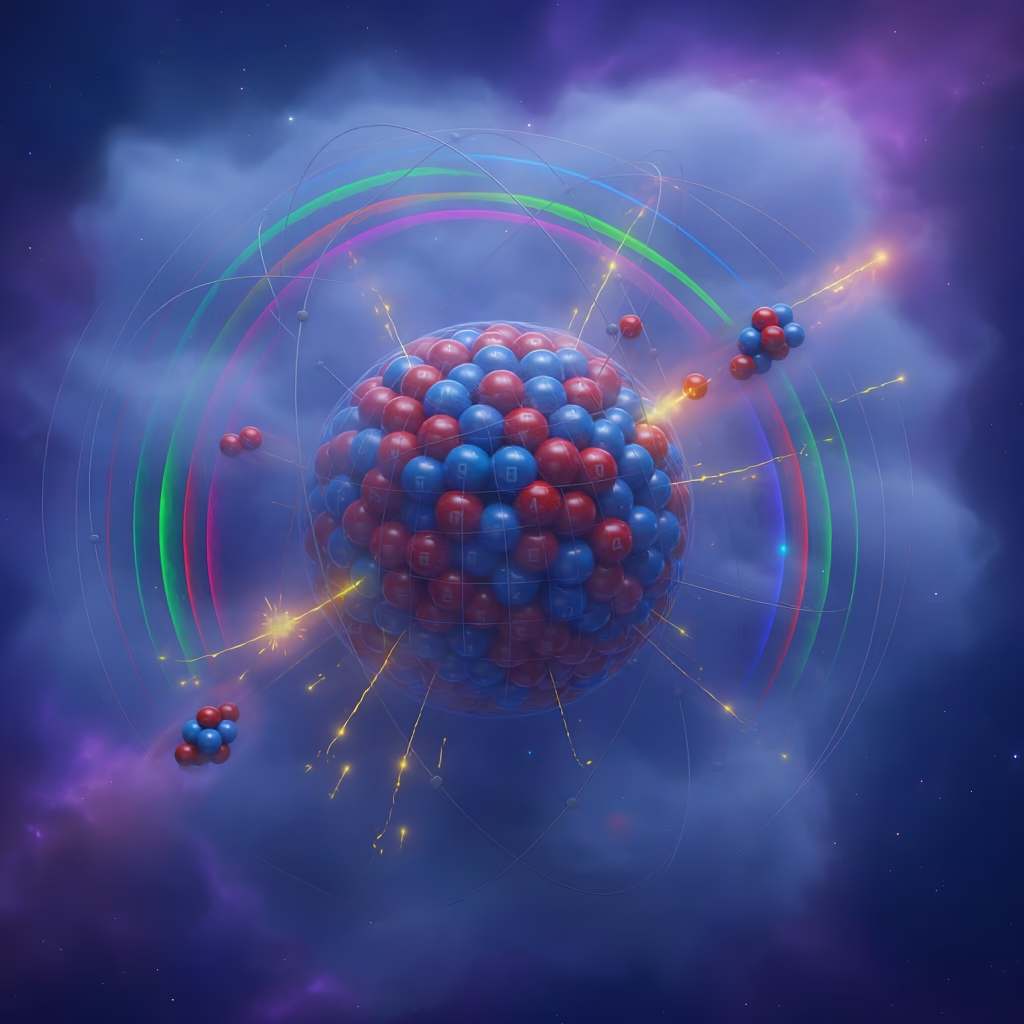
What exactly makes an element “heavy” in the grand theater of space? Astronomers draw the line at iron (atomic number 26). Lighter elements like hydrogen and helium bubbled up mere minutes after the Big Bang’s explosive debut. From there, stars took the baton, fusing atoms up to iron in their scorching cores—a process that pumps out energy. But pushing beyond iron? That’s a losing battle for stars. Fusion of heavier nuclei guzzles more energy than it releases, halting the stellar forge.
Enter the realm of superheavy elements, where creation demands apocalyptic extremes. These atoms, from gold (79) to uranium (92) and beyond, arise via the rapid neutron-capture process—affectionately dubbed the “r-process.” Picture atomic nuclei as greedy sponges, slurping up neutrons at blistering speeds in neutron floods so dense they defy everyday physics. Temperatures soar to billions of degrees, neutron densities hit trillions per cubic centimeter. No garden-variety star can muster this; only cataclysmic events like supernovae or neutron star smash-ups qualify.
For years, debates raged: Were supernovae the r-process kings, or did neutron star mergers steal the show? Recent data crowns the mergers, as we’ll see.
The Game-Changing GW170817: Neutron Star Merger Breakthrough
Fast-forward to August 17, 2017—a date etched in astrophysics lore. Gravitational wave observatories LIGO and Virgo caught GW170817, the rippling spacetime echo of two neutron stars spiraling into oblivion 140 million light-years away. These ultra-dense stellar corpses, each packing 1.4 solar masses into a 20-kilometer sphere, unleashed a symphony of destruction.
Telescopes worldwide zeroed in, capturing the merger’s fireworks across radio waves to gamma rays. The highlight? A kilonova—a dazzling afterglow from the ejected wreckage, glowing 1,000 times brighter than a nova. Spectroscopic sleuthing of this light unveiled telltale signs of r-process magic: absorption lines screaming heavy rhenium, strontium, and lanthanides. Peer-reviewed papers in The Astrophysical Journal Letters crunched the numbers, estimating the event spewed 5-10 Earth masses of neutron-rich debris, churning out gold equivalent to several Earths’ worth.
Astrophysicist Brian Metzger from Columbia University calls these mergers “cosmic neutron blizzards.” Their ejecta—spewed at 20% light speed—bathe in free neutrons, fueling r-process frenzy. Unlike supernovae’s patchy yields, mergers deliver consistent heavy-element hauls, reshaping our view of cosmic forges.
Spotlight on Californium-254: The Superheavy Star of the Show
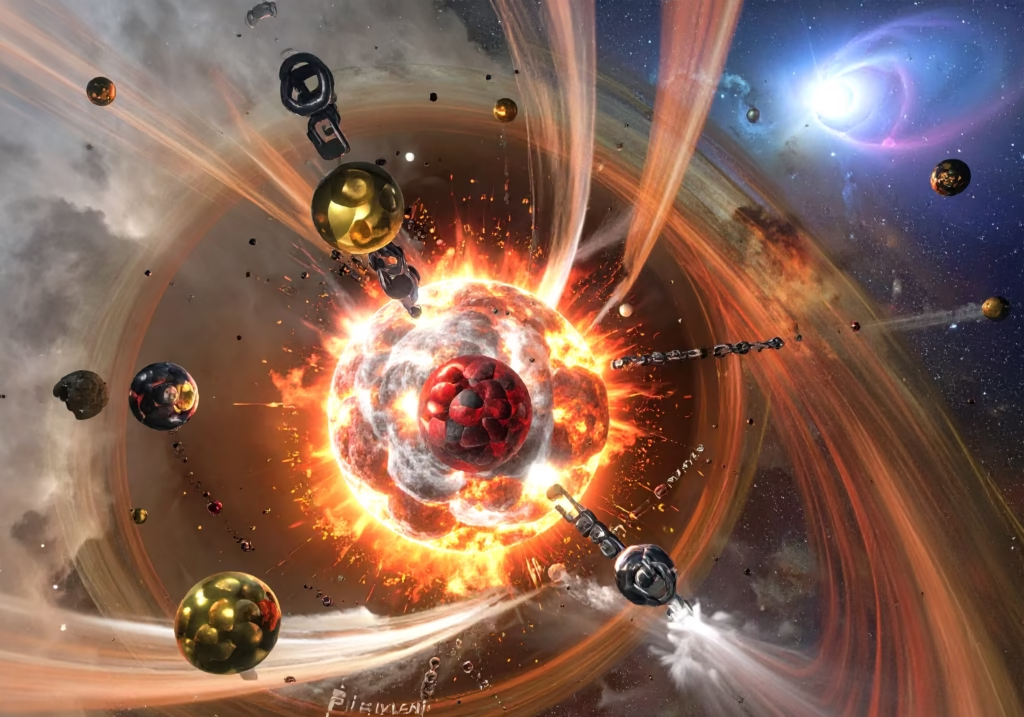
The plot thickened in 2021. Scientists poring over data from GRB 20190827D—a short gamma-ray burst tied to a kilonova—spotted something extraordinary: californium-254 (atomic number 98, mass 254). On Earth, californium is lab-born, fleeting (half-life ~65 days), and uranium-heavier. In space? This marked the heaviest element ever directly inferred from cosmic spectra.
Published in Nature, the study dissected the kilonova’s late glow. Most kilonovae dim quickly, but this one lingered weeks, its light curve mirroring Cf-254’s radioactive decay chain. As the isotope fissions, it dumps heat into surrounding debris, powering prolonged brilliance—like a slow-burning cosmic lantern. Models ruled out lighter culprits; only Cf-254 fit the energy release profile perfectly.
Co-author Jennifer Barnes from Columbia highlighted how Cf-254’s “radioactive lantern effect” sustains kilonova shine, proving mergers sculpt nuclei way past Earth’s natural periodic table end (up to 92). This isn’t theory—it’s spectral smoking gun, confirming r-process peaks at superheavies.
Unraveling Elements: The Spectral Detective Toolkit
How do astronomers ID these elusive beasts amid chaos? Spectra are their Rosetta Stone. Every element imprints unique “fingerprints” on light—bright emission lines or dark absorption troughs from electrons jumping energy levels. Hydrogen’s red glow? Iconic Balmer lines. Gold? Trickier, buried in kilonova clutter.
Kilonovae ejecta teem with 10,000+ unstable isotopes, smearing spectra into a messy mosaic. No pristine lines for superheavies; instead, experts wield supercomputers simulating nuclear decay chains, atomic physics, and radiative transfer. They match observed light curves (brightness over time) and spectra to predicted r-process yields. For Cf-254, the clincher was heating rates: decay energy matching the glow’s persistence.
Analogy time: It’s like forensic DNA matching in a riot—piecing fragmented clues from thousands of suspects. Challenges abound—superheavies decay in seconds, leaving indirect glow traces—but JWST and ELT telescopes sharpen the hunt.
Cosmic Chemistry Revolution: From Space Forges to Earth’s Treasures
These detections rewrite the periodic table’s origin story. Stars handle fusion up to iron; mergers monopolize the heavy end. A single event rivals Earth’s mass in platinum-group metals. Simulations peg mergers as gold’s primary source—perhaps 50-100 billion years ago, ancient collisions seeded our planet’s bullion.
Enrico Ramirez-Ruiz of UC Santa Cruz dubs them “alchemical blast furnaces,” fueling galactic evolution. Milky Way halo stars, born early, flaunt r-process enrichment (europium spikes), fingerprinting primordial mergers. This informs chemical tagging: tracking elements’ birthplaces across galaxies.
Bonus: Rare earths in your phone? Likely merger-born. Understanding this boosts nucleosynthesis models, predicting element budgets universe-wide.
Pushing Boundaries: Even Heavier Elements on the Horizon?
Californium-254 holds the record, but is it the limit? R-process theory forecasts fission cycling up to atomic number 110+ (e.g., seaborgium traces). Yet, hyperheavies decay too fast for direct sight—seconds to microseconds—challenging detectors.
Limits stem from spectral blur and model uncertainties. Still, promise abounds: LISA (2030s gravitational waves), Roman Space Telescope, and 30m ground scopes will dissect fainter kilonovae. Multi-messenger astronomy—merging waves, light, neutrinos—will map full yields. Ongoing simulations refine “third peak” r-process (A~254), potentially unearthing einsteinium or beyond.
Why This Matters: Universe’s Extreme Forge Unveiled
Spotting californium-254 in a neutron star merger cements these collisions as the heaviest element factories in space. Far beyond stellar fusion’s iron cap, r-process demands merger mayhem: neutron deluges birthing the periodic table’s edge. This isn’t abstract—it’s the backstory of Earth’s gold veins, tech metals, and cosmic diversity.
These insights propel astrophysics, refining galaxy formation sims and element hunts. As detectors evolve, we’ll decode more, blurring lab-cosmos lines. The universe, it turns out, is the ultimate particle accelerator.
for more interesting news visit BulletinBuzzs