Draconid Meteor Shower 2026: When, Where, and How to Watch the October Night Sky
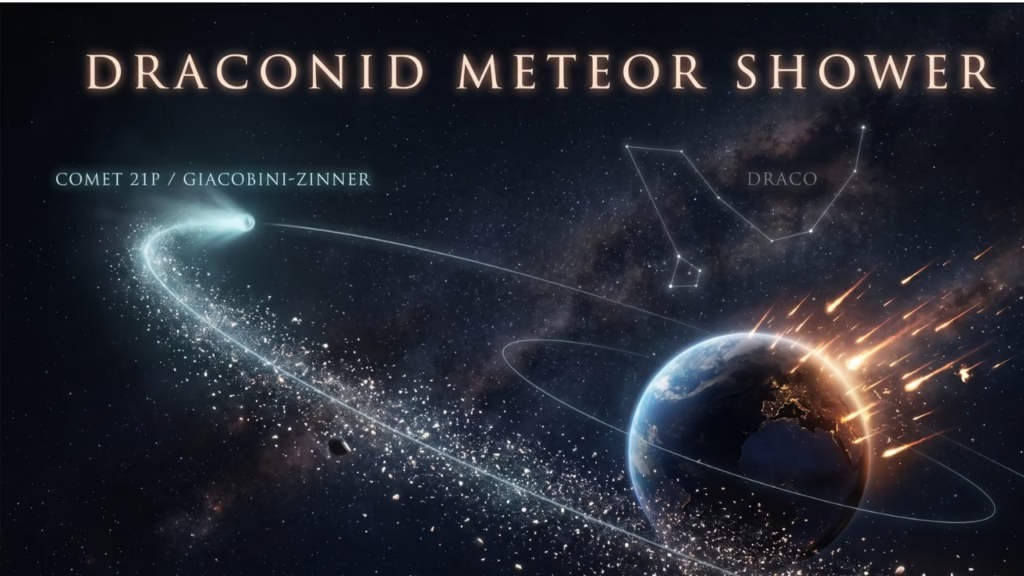
Autumn brings crisp evening air and some of the most captivating celestial events of the year. Chief among early October’s skywatching highlights is the Draconid meteor shower, an annual celestial display famous for its early-evening timing, rich history of unexpected meteor storms, and connection to a wandering periodic comet.
In 2026, stargazers have reason to celebrate: the Draconids peak under nearly pristine, moonless conditions. Unlike the 2025 shower, which was largely washed out by a bright, unforgiving full moon, the 2026 Draconids coincide with a waning lunar crescent just before the new moon. This comprehensive guide covers everything you need to know about the Draconid meteor shower in 2026—key peak dates, radiant mechanics, historical outbursts, optimal viewing strategies, and practical astrophotography advice.
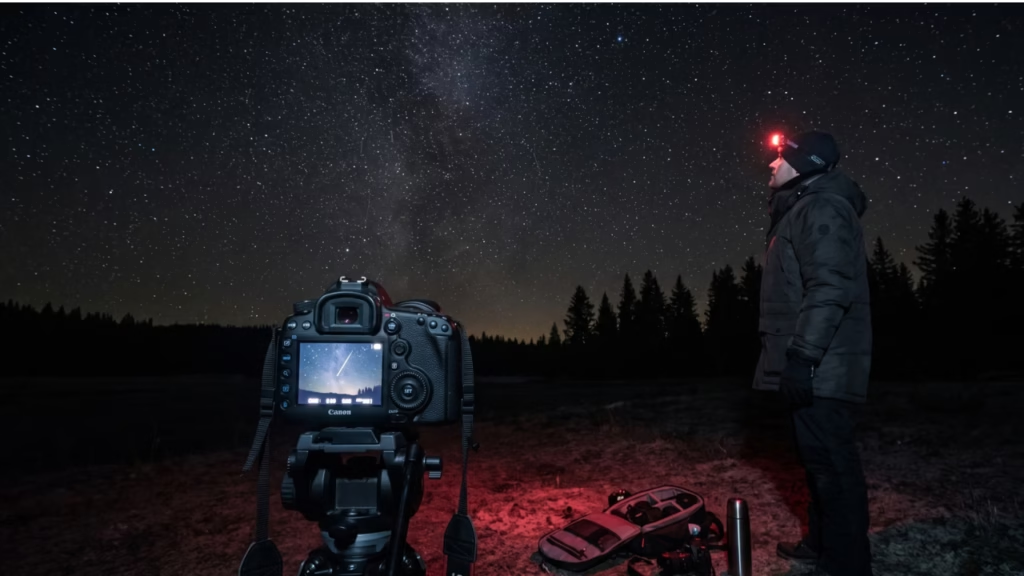
At a Glance: Key Fast Facts for the 2026 Draconids
| Parameter | Details |
| Active Period | October 6 – October 10, 2026 |
| Peak Night | Overnight October 8–9, 2026 |
| Peak Timing | Around 9:00 p.m. EDT (Oct. 8) / 01:00 GMT (Oct. 9) |
| Parent Body | Comet 21P/Giacobini-Zinner |
| Constellation of Radiant | Draco (The Dragon) |
| Expected Zenithal Hourly Rate (ZHR) | ~5 meteors per hour under dark skies |
| Lunar Phase | Slim waning crescent (New Moon on October 10) |
| Atmospheric Entry Velocity | Slow (~20 km/s or ~45,000 mph) |
| Best Viewing Window | Nightfall through late evening (8:00 p.m. – midnight) |
What Is the Draconid Meteor Shower?
The Draconid meteor shower, historically called the Giacobinids, is an annual meteor stream occurring each year during early to mid-October. Most meteor showers occur when the Earth crosses orbital paths laden with dusty remnants ejected by comets or asteroids. As our planet hurtles along its orbit at approximately 67,000 miles per hour, these minuscule specks collide with the upper atmosphere.
Friction with atmospheric gas atoms compresses and superheats the air immediately ahead of the incoming meteoroid particle, creating an incandescent channel of ionized gas that observers on the ground witness as a momentary “shooting star.”
What makes the Draconids unique among major annual displays is twofold:
-
Entry Speed: Draconid meteoroids encounter Earth from behind or at oblique angles relative to Earth’s orbital path. Consequently, their relative entry velocity is only about 20 kilometers per second (45,000 mph)—substantially slower than the blistering speeds of showers like the Perseids (59 km/s) or Leonids (71 km/s). This produces distinctive, leisurely streaks across the firmament rather than instantaneous flashes.
-
Early-Evening Peak: While most meteor showers demand waking up in the freezing pre-dawn hours between 2:00 a.m. and 5:00 a.m., the Draconids favor the early bird. The shower is best viewed immediately after nightfall.
When to Watch: Dates, Peak Times, and Lunar Phase in 2026
The Draconids have a comparatively compact activity envelope. While broader showers such as the Perseids or Orionids span several weeks, the Draconids remain active for only five days:
-
Active Window: October 6 through October 10, 2026
-
Peak Display: Overnight on October 8 into the morning of October 9, 2026
Astronomical calculations indicate that the core peak occurs around 9:00 p.m. Eastern Daylight Time (EDT) on October 8, translating to 01:00 Greenwich Mean Time (GMT) on October 9.
The Moon Phase Advantage in 2026
Moonlight is the single most common spoiler of meteor showers. A bright gibbous or full moon acts as natural light pollution, washing out fainter meteors and reducing visible tallies by as much as 80% to 90%.
In 2026, observers benefit from near-perfect lunar geometry. The New Moon falls on October 10, 2026. During the shower’s peak on October 8–9, the Moon is a negligible, razor-thin waning crescent that does not rise until shortly before dawn. This provides astronomers and casual stargazers with an ink-black canvas during prime evening viewing hours.
Where to Look: Locating the Radiant in Constellation Draco
Meteor showers take their scientific names from the astronomical constellation in which their apparent point of origin—the radiant—resides. To a viewer on the ground, tracing the path of several Draconid meteors backward shows them converging toward a point in the northern sky within the constellation Draco the Dragon.
Understanding the Constellation Draco
Named from the Latin term draco, meaning “huge serpent” or “dragon,” Draco is the eighth-largest constellation by area in the modern night sky. Despite its sprawling reach across 1,083 square degrees, it is relatively inconspicuous because it lacks zero- or first-magnitude stars.
Instead, Draco snakes its way between brighter celestial landmarks:
-
It winds between Ursa Major (the Great Bear, containing the Big Dipper) and Ursa Minor (the Little Bear, containing the North Star, Polaris).
-
The Dragon’s triangular head—traditionally formed by the stars Eltanin (Gamma Draconis), Rastaban (Beta Draconis), Grumium (Xi Draconis), and Kuma (Nu Draconis)—sits near the bright star Vega in the constellation Lyra.
Why You Should NOT Stare Directly at the Radiant
A common misconception among beginner stargazers is that one should stare directly at the radiant constellation to see meteors. In reality, looking straight at Draco is counterproductive:
-
Meteors originating directly in front of your line of sight appear as short, abrupt flashes or points of light due to foreshortening.
-
The longest, most dramatic streaks occur between 30 to 45 degrees away from the radiant.
For the best visual experience, face generally north or northwest, look upward toward the zenith (the highest point overhead), and take in as broad an expanse of the sky as possible.
Why Early Evening Is Best
Most meteor showers produce their highest counts after midnight because an observer’s location on Earth has rotated directly into the forward-facing windshield of Earth’s orbital trajectory. However, the Draconids are an exception because Draco is a circumpolar constellation for most mid-to-high northern latitudes.
Draco reaches its highest position above the northern horizon shortly after sunset. As the radiant sits high in the evening sky, the path of incoming meteoroids has less atmosphere to traverse before reaching your vantage point. By the time 3:00 a.m. rolls around, Draco sinks closer to the northern horizon, significantly diminishing the observable rate.
Origins and Science: Comet 21P/Giacobini-Zinner
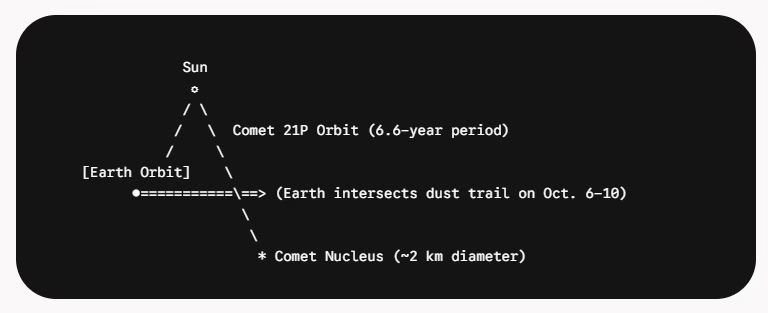
The cosmic parent responsible for the Draconid meteor stream is Comet 21P/Giacobini-Zinner, a small periodic Jupiter-family comet that completes an elliptical circuit around the Sun once every 6.6 years.
The Discovery of the Comet
The comet possesses a dual namesake honoring two independent observers:
-
Michel Giacobini: A French astronomer working at the Nice Observatory in France, who first discovered the faint icy wanderer on December 20, 1900.
-
Ernst Zinner: A German astronomer who re-observed and confirmed the periodic comet two orbits later on October 23, 1913, at the Remeis Observatory in Bamberg, Germany.
Following standard astronomical naming conventions, the periodic comet received the catalog designation 21P, identifying it as the 21st recognized periodic comet in astronomical history.
Composition: A “Dirty Snowball” in Deep Space
Comet 21P/Giacobini-Zinner is relatively compact, measuring approximately 1.24 miles (2.0 kilometers) in diameter. Like most cometary nuclei, it is essentially a porous “dirty snowball”—a conglomeration of water ice, frozen methane, ammonia, carbon monoxide, and primordial silicate dust leftover from the formation of the solar system 4.6 billion years ago.
As the comet nears perihelion (its closest approach to the Sun), solar radiation warms its volatile surface. Sublimating gases expand outward into space, carrying millions of rocky grit particles and gravel-sized fragments with them. This process seeds a ribbon of debris along the comet’s orbital ellipse. Every October, Earth plows directly through this debris field.
Historical Outbursts: From Gentle Showers to Wild Meteor Storms
Under typical baseline conditions, the Draconids are a calm, modest shower. The standard expected Zenithal Hourly Rate (ZHR) is approximately 5 meteors per hour. However, the Draconids hold a legendary reputation among astronomers because they are prone to explosive, unpredictable outbursts.
The Great Storms of the 20th Century
When Earth crosses the comet’s orbital plane shortly after the comet itself has passed, our planet can intercept the fresh, densely concentrated filament of the debris stream. When this happens, the shower transforms from a quiet trickle into a blizzard of shooting stars:
-
1933 Storm: In October 1933, observers across Europe witnessed one of the most astonishing astronomical spectacles of the modern era. Skywatchers reported rates exceeding 5,000 to 10,000 meteors per hour—a true meteor storm where streaks appeared faster than observers could count.
-
1946 Storm: Thirteen years later, during another favorable orbital alignment, observers across North America and Europe were treated to another intense storm, recording rates between 3,000 and 4,000 meteors per hour.
-
Secondary Outbursts (1926, 1952, 1985, 1998, 2011): While not reaching storm levels of thousands per hour, secondary encounters produced hundreds of meteors per hour. The 2011 return, for example, generated strong visual and radar rates exceeding 300 meteors per hour across parts of Europe.
What to Expect for 2026
For October 2026, professional dynamicists and meteor modeling networks do not forecast a close encounter with fresh, concentrated dust trails. The baseline projection remains steady at around 5 meteors per hour.
However, cometary debris clouds are notoriously chaotic. Subtle gravitational nudges from Jupiter and the Sun can shift old streams into unexpected paths. Veteran skywatchers always keep a watchful eye on the Draconids, as an unexpected spike can transform a quiet evening into a memorable celestial show.
How to Prepare for the Best Viewing Experience
Watching a meteor shower does not require advanced technical skills, but a small amount of preparation makes a dramatic difference in how many meteors you actually catch.
1. Escape Light Pollution
Artificial light is the greatest barrier to seeing meteors. Streetlights, commercial signage, and urban glow obliterate faint meteors.
-
Consult online dark-sky maps (such as DarkSiteFinder or LightPollutionMap) to locate areas classified under Bortle Class 1 to 4.
-
State parks, national forests, coastal beaches, and rural farmland provide significantly superior vantage points compared to urban parks or backyards.
2. Allow Time for Dark Adaptation
Human eyes rely on rhodopsin (visual purple) for night vision, which takes 20 to 30 minutes of unbroken darkness to fully activate.
-
Avoid looking at mobile phones, smartwatches, or car headlights. A single glance at a bright white screen resets your night adaptation instantly.
-
If you need illumination to navigate, use a flashlight equipped with a deep red filter, which preserves your scotopic vision.
3. Dress for Dropping Temperatures
October nights cool off rapidly once the Sun sets. Because meteor watching involves lying motionless for extended stretches, you will feel the cold much faster than if you were moving.
-
Dress in insulating layers: thermal base layers, a windproof outer jacket, wool socks, and a knit beanie.
-
Bring a reclining lawn chair, a camping pad, and a sleeping bag or heavy wool blanket so you are comfortably insulated from the cold, damp ground.
4. Skip Telescopes and Binoculars
Optical equipment like binoculars and telescopes magnifies small patches of sky, which is ideal for studying lunar craters or the rings of Saturn. However, meteors flash unpredictably across vast swaths of sky. Looking through a lens dramatically narrows your field of view, ensuring you will miss nearly every shooting star. Your naked eyes are the best tool.
Astrophotography Guide: Capturing the 2026 Draconids
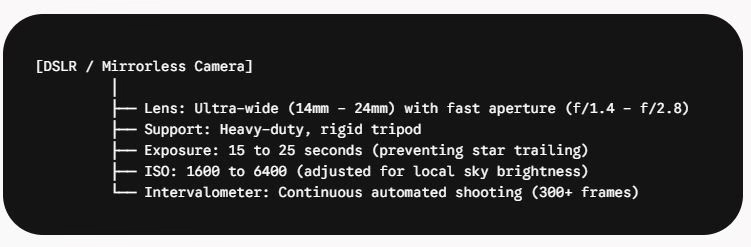
Because Draconid meteors move slower across the sky than many other streams, they leave clean, distinct trails on camera sensors. Here is a recommended camera setup for capturing the shower:
-
Focus Manually: Switch your autofocus to manual (
MF). Turn on live view, zoom in on a bright star (such as Vega or Polaris), and slowly rotate your focus ring until the star is as small and pinpoint-sharp as possible. Tape the focus ring down with gaffer tape to keep it from slipping. -
Use an Intervalometer: Set an external or in-camera intervalometer to take continuous back-to-back exposures (e.g., 20 seconds each with a 1-second interval). Let the camera shoot undisturbed for several hours.
-
Dew Mitigation: Autumn air brings rapid condensation. Wrap an electric USB-powered lens heater strip around your lens barrel to prevent moisture from fogging your front element.
Frequently Asked Questions (FAQ)
What is the difference between a meteorite meteor, meteoroid, and meteorite?
-
A meteoroid is a small particle of rock or ice floating through space.
-
A meteor is the visible flash of light produced when a meteoroid enters Earth’s atmosphere and vaporizes.
-
A meteorite is any fragment of the meteoroid that survives its fiery atmospheric passage and lands on Earth’s surface. Because Draconid particles are fragile, porous cometary grains, they almost never survive to become meteorites.
Can the Draconid shower be seen from the Southern Hemisphere?
The Draconids are overwhelmingly a Northern Hemisphere event. Because the radiant in Draco is located far into the northern celestial sphere (declination +54°), it remains low on the horizon or entirely below the horizon for observers located south of the equator. Southern Hemisphere observers will spot very few, if any, Draconids.
If the weather is overcast, what should I do?
If clouds threaten the peak night of October 8–9, do not hesitate to scout the skies on the adjacent evenings of October 7 or October 9. While meteor numbers drop noticeably away from the peak, clear skies on an off-peak night are always preferable to overcast conditions during the theoretical maximum.
Summary Checklist for October 8–9, 2026
-
Monitor the local forecast for clear skies and low fog.
-
Locate a dark-sky site away from streetlamps and suburban lighting.
-
Set up early (starting around 7:30 p.m. to 8:30 p.m. local time).
-
Pack warm layers, a reclining chair, and a thermos of a warm drink.
-
Give your eyes 30 minutes to adjust without looking at screens.
-
Look toward the overhead northern sky and enjoy the slow-moving celestial fireworks.
What is PRANOS?