Pranos Fusion: Forging India’s Path to Commercial Nuclear Fusion and Energy Sovereignty
The global energy landscape is standing at a critical crossroads. As the demand for electricity skyrockets—driven by global electrification initiatives and the energy-hungry demands of advanced computing and artificial intelligence—the limitations of our current power grids are becoming starkly apparent. While renewable sources like solar and wind have made massive strides, they continue to struggle with providing reliable, 24/7 baseload power due to their inherent intermittency.
Traditional nuclear fission offers consistent baseload capability but is consistently weighed down by concerns over long-half-life radioactive waste and geopolitical hurdles. For decades, the undisputed “holy grail” of clean energy has been nuclear fusion—the very process that powers the sun. Now, an Indian deep-tech startup is stepping onto the global stage to make this elusive dream a commercial reality.
In a landmark move for India’s deep-tech ecosystem, Bengaluru-based Pranos Fusion has emerged as a frontrunner in the race to commercialize fusion energy. Backed by prominent investors like Pi Ventures and Ankur Capital, Pranos is building India’s first privately developed tokamak.
The Promise and Challenge of Nuclear Fusion
To understand the significance of Pranos Fusion’s undertaking, one must first grasp the magnitude of the fusion challenge. Nuclear fusion involves combining light atomic nuclei, such as hydrogen isotopes, to form heavier ones, releasing a massive amount of energy in the process. Unlike nuclear fission, which splits heavy atoms and produces hazardous, long-lasting radioactive waste, fusion is inherently safe. It produces no high-level radioactive waste, carries zero risk of a meltdown, and relies on fuels that are abundant in nature.
However, replicating the conditions of the sun on Earth is arguably the hardest engineering problem ever attempted by humanity. It requires confining superheated plasma at temperatures exceeding 100 million degrees Celsius—far hotter than the core of the sun. The most promising method for achieving this is magnetic confinement, which uses powerful magnetic fields to trap and squeeze the plasma inside a donut-shaped device known as a tokamak.
For decades, fusion has been confined to massive, publicly funded government laboratories. The joke in the scientific community has long been that “fusion is 30 years away, and always will be.” But today, that narrative is rapidly shifting, transitioning from theoretical physics to actionable, iterative engineering.
Enter Pranos Fusion: India’s Deep-Tech Vanguard
Founded in May 2024 by Shaurya Kaushal and Roshan George, Pranos Fusion is a Bengaluru-based seed-stage company that is aggressively attacking the fusion problem. The founding duo brings a potent combination of complementary skills to the table. Shaurya Kaushal, the CEO, brings deep first-principles modeling and systems intuition, while Roshan George, the COO, contributes applied AI/ML expertise and a software-and-controls mindset.
Together, they have assembled a formidable 12-member global team possessing deep domain expertise in plasma physics, artificial intelligence, high-power subsystems, cryogenics, and superconducting materials. Their objective is clear: build a high-barrier, sovereign fusion stack for India.
Pranos is not merely focusing on isolated components; the company is developing a fully integrated stack that marries plasma physics, superconducting magnets, and advanced control software into a functional commercial tokamak.
The Technological Blueprint: Apple-Shaped Tokamaks
At the heart of Pranos Fusion’s strategy is the development of “low aspect ratio” tokamaks. Traditional tokamaks, like the massive ITER project being built in France, are shaped like a classic doughnut. Low aspect ratio tokamaks, by contrast, are more compact and “apple-shaped.” This geometric shift offers significant advantages in both performance and form factor, allowing for higher plasma pressure relative to the magnetic field strength—a crucial metric for efficiency.
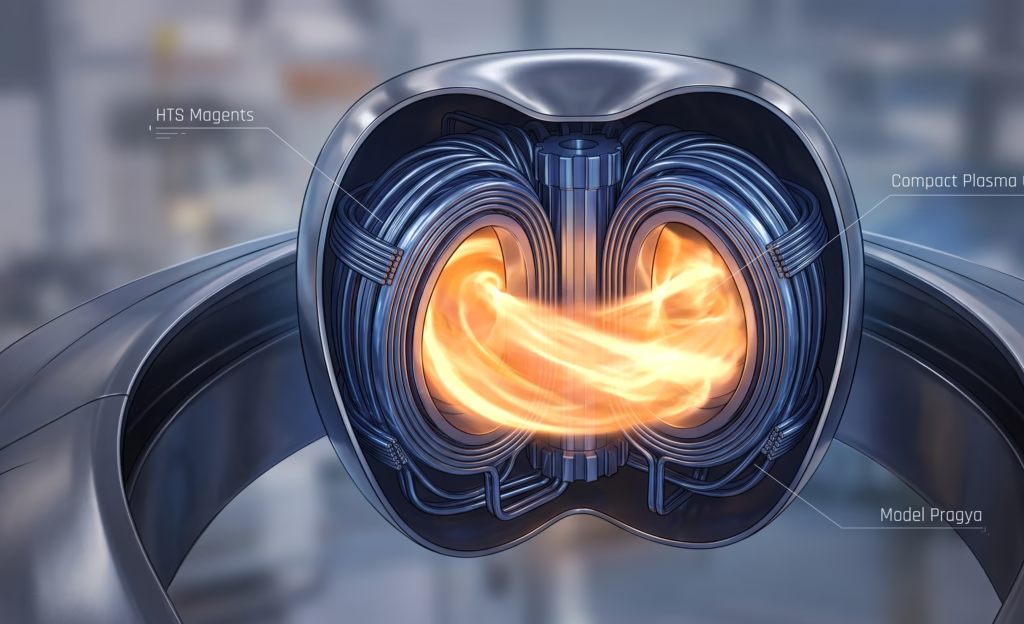
Pranos has laid out a highly methodical, step-by-step roadmap to commercialization:
1. The ‘Pragya’ Demonstrator
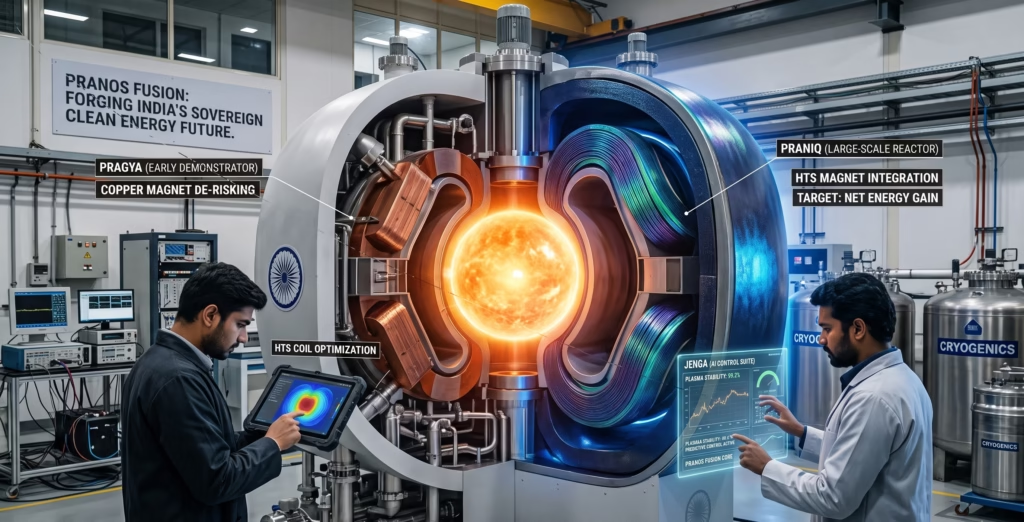
The first phase of their physical roadmap is Pragya, a Magnetic Plasma Confinement Demonstrator. Instead of jumping straight to complex, unproven materials, Pragya utilizes traditional copper magnets as an early de-risking step. This machine is slated for operationalization this year. By getting a physical machine up and running rapidly, Pranos aims to achieve vital design validations and test downstream subsystems in a real-world environment.
2. The ‘PraniQ’ Reactor
Building on the foundation laid by Pragya, Pranos plans to transition to its larger-scale reactor, PraniQ. The critical leap here is the integration of High-Temperature Superconductor (HTS) magnets. These advanced magnets will allow PraniQ to generate much stronger magnetic fields in a smaller volume, pushing the reactor toward the ultimate goal of net energy gain (where the reactor produces more energy than it consumes).
3. The ‘Jenga’ Software Suite
Hardware alone cannot solve fusion. Controlling plasma at 100 million degrees requires split-second precision and predictive modeling. In parallel to its physical reactors, Pranos is developing Jenga, an end-to-end modeling and simulation suite. As the physical reactors mature, Jenga will evolve from a simulation platform into a live monitoring and control suite for PraniQ, utilizing applied AI to maintain plasma stability.
To accelerate timelines, Pranos is adopting a focused developmental approach. They are concentrating heavily on the core tokamak architecture while openly collaborating with specialized partners to integrate downstream subsystems, avoiding the trap of trying to reinvent the wheel across the entire supply chain.
Financial Backing and Market Confidence
Building a fusion reactor is capital-intensive. However, the investment landscape for deep tech has matured significantly. Pranos Fusion recently raised $7.22 million across two seed rounds, drawing backing from prominent deep-tech venture capital firms, including Pi Ventures and Ankur Capital. The company’s post-money valuation currently stands at a robust figure, reflecting immense investor confidence in both the team and the technology.
Pi Ventures, known for backing foundational technologies capable of seismic industrial shifts, noted that fusion is a “quintessential deeptech challenge… high-barrier, high-impact, and inherently global.” Their investment signals a broader trend: venture capital is increasingly willing to underwrite hardware and physics risks if the potential upside is limitless clean energy. Ankur Capital similarly noted that from their first meetings with the founders, it was evident they possessed the execution-led mindset required for this monumental task.
The “Why Now” Factor: An Inflection Point
Why are private startups suddenly attempting what governments have struggled to achieve for decades? A confluence of three factors has created a true inflection point for nuclear fusion:
1. Maturation of High-Temperature Superconductors (HTS)
The discovery and commercialization of HTS materials, such as REBCO (Rare-Earth Barium Copper Oxide) tapes, have fundamentally rewritten the rules of tokamak design. HTS allows magnets to generate dramatically higher magnetic fields while operating at temperatures that, while still cryogenic, are much easier to maintain than those required by older low-temperature superconductors. Stronger magnetic fields mean better plasma confinement, which directly translates to shrinking the reactor size. Designs that were previously “lab-only” theoretical models are now buildable and economically viable.
2. A Rich Subsystem Ecosystem
Public programs like ITER and national laboratories have spent decades retiring the long-horizon physics risks. They have advanced diagnostic tools, control theories, and material sciences to a point where private companies can step in and iterate rapidly on hardware. Today, a rich ecosystem of specialized partners exists, providing off-the-shelf high-power subsystems, diagnostics stacks, and cryogenics. A startup like Pranos no longer has to build everything from scratch.
3. The Global Energy Crisis
The macro-environment has never been more desperate for baseload clean energy. With tech giants searching for dedicated nuclear reactors to power massive AI data centers, the commercial market for a working fusion reactor is essentially infinite.
India’s Strategic Imperative and Policy Tailwinds
For India, nuclear fusion is not just an environmental play; it is a matter of profound strategic and geopolitical importance. As the world’s fastest-growing major economy, India’s energy demands are surging. Relying entirely on imported fossil fuels or intermittent renewables leaves the country vulnerable.
India’s push for energy security and strategic tech autonomy is driving a modernization of its regulatory frameworks. A notable example is the proposed SHANTI Bill, designed to open pathways for private participation in the nuclear sector with clearer regulatory and liability frameworks. While fusion technology will eventually require its own tailored regulatory approach distinct from traditional fission, this policy direction signals New Delhi’s seriousness about mobilizing the private sector.
By backing Pranos, investors are aligning with India’s long-term imperative to build sovereign capabilities in critical energy technologies. Owning the IP for commercial fusion would elevate India from an energy importer to a global energy superpower.
The Global Competitive Landscape
Pranos is not operating in a vacuum. The private fusion sector is booming globally. According to market data, Pranos has over 60 active competitors worldwide.
Leading the pack are heavily funded titans like Commonwealth Fusion Systems (CFS) in the United States, which has raised over $4 billion; Canada’s General Fusion ($515M); and TAE Technologies ($1.32B).
While these competitors have a significant head start in capital, the fusion race is not a winner-take-all scenario. The global energy market is vast enough to support multiple successful designs and technologies. Furthermore, Pranos’ positioning in India offers unique advantages: access to a world-class pool of engineering talent at a fraction of the cost, proximity to robust domestic manufacturing capabilities, and a highly supportive policy environment pushing for indigenous deep tech.
Conclusion: A Long Road, But the Right Path
The journey to commercial nuclear fusion remains fraught with unprecedented engineering challenges. Handling immense heat, managing the structural integrity of materials over time, and achieving consistent, reliable net energy gain are hurdles that have not yet been fully cleared by anyone.
However, Pranos Fusion’s swift transition from theoretical research to the physical execution of the Pragya demonstrator within just a few years of founding is a testament to a new era of agile, privately-funded hardware development.
By combining low aspect ratio tokamak geometry, next-generation HTS magnets, and AI-driven control software, Shaurya Kaushal and Roshan George are positioning Pranos at the cutting edge of global energy innovation. As they prepare to bring their first demonstrator online, the world—and India in particular—will be watching closely. If successful, Pranos will not just be building a power plant; they will be forging the ultimate solution to humanity’s energy and climate crises.
for more informative content visit BB daily