The Science of Lunar Impact: Lessons from the Artemis II Flyby
For over fifty years, the Moon’s far side remained a silent witness to the cosmic bombardment that shapes our solar system. However, during the historic Artemis II mission, a new chapter of lunar science was written. While traversing the lunar landscape at over miles from Earth, astronauts witnessed a phenomenon rarely seen by human eyes: real-time meteorite impacts.
This guide explores the physics of these “impact flashes,” the scientific implications for future lunar habitation, and why these observations have fundamentally changed our understanding of the Moon’s geological activity.
1. What are Lunar Impact Flashes?
When a meteorite strikes the Moon, it is not just a collision—it is a massive energy transfer. Unlike Earth, the Moon lacks a substantial atmosphere to burn up incoming space debris through friction. Instead, these objects strike the surface at hyper-velocities.
The Physics of the Flash
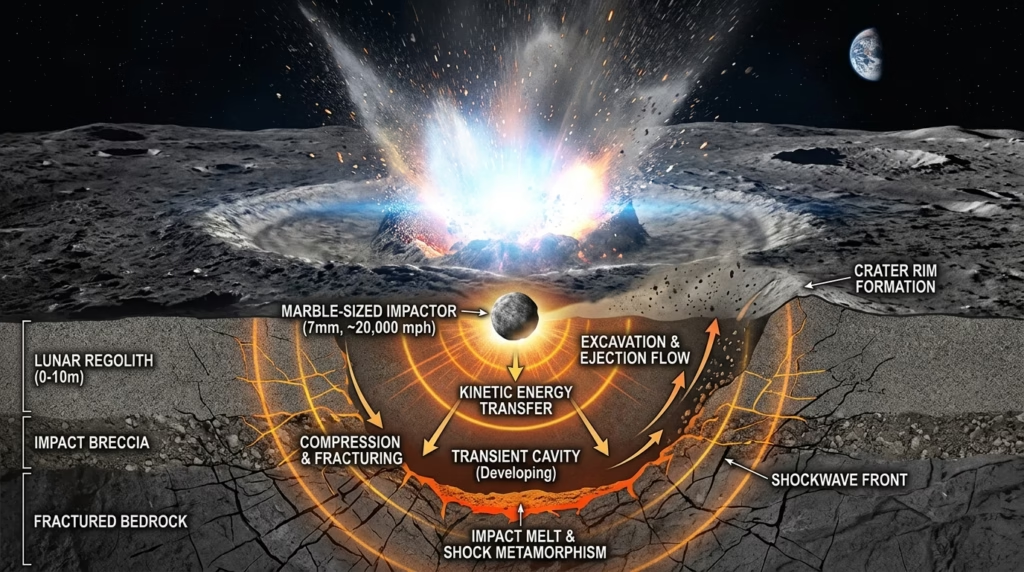
A meteorite striking the lunar surface typically travels at speeds ranging from to miles per hour. Upon impact, the kinetic energy () is instantaneously converted into:
-
Thermal Energy: The impact site reaches temperatures of thousands of degrees.
-
Vaporization: Both the meteorite and the lunar soil (regolith) are vaporized into a glowing plasma.
-
Light: This plasma creates a “pinprick of light” visible from space.
The Artemis II crew reported these flashes as lasting only a millisecond—faster than a camera shutter—and described the color as white to bluish-white. This color temperature suggests an incredibly high-energy event, indicating the intense heat generated at the moment of contact.
2. The Artemis II Discovery: By the Numbers
During a concentrated seven-hour observation period, the crew—Commander Reid Wiseman, Jeremy Hansen, Victor Glover, and Christina Koch—documented a series of impacts that surprised ground control.
The “Eclipse” Advantage
Interestingly, many of the sightings occurred while the Moon passed in front of the Sun. This positioning created a unique lighting environment, reducing glare and allowing the astronauts’ eyes to adjust to the high-contrast environment of the lunar nightside, making the “pinpricks” of light much more visible.
3. Why These Observations Matter for Science
Before Artemis II, most lunar impact data came from the Lunar Reconnaissance Orbiter (LRO) or ground-based telescopes on Earth. However, human observation provides a unique “real-time” validation that automated systems sometimes miss.
Estimating Projectile Size
Bruce Betts, Chief Scientist at the Planetary Society, notes that these flashes help determine the daily flux of space debris. If an object is large enough to create a flash visible to the naked eye from a spacecraft, it isn’t a mere speck of dust.
-
Micrometeoroids: Usually too small to be seen individually.
-
Meter-sized Boulders: Rare and would cause a significantly larger, more sustained flash.
-
The Artemis Strikes: These likely represent objects the size of a marble or a small stone, packing enough velocity to release immense energy.
Geological “Freshness”
By matching the crew’s timestamps with satellite data, scientists can locate the fresh craters created by these specific strikes. This allows researchers to study “new” lunar soil that hasn’t been weathered by solar radiation for millions of years.

4. Engineering Challenges: Protecting Future Lunar Bases
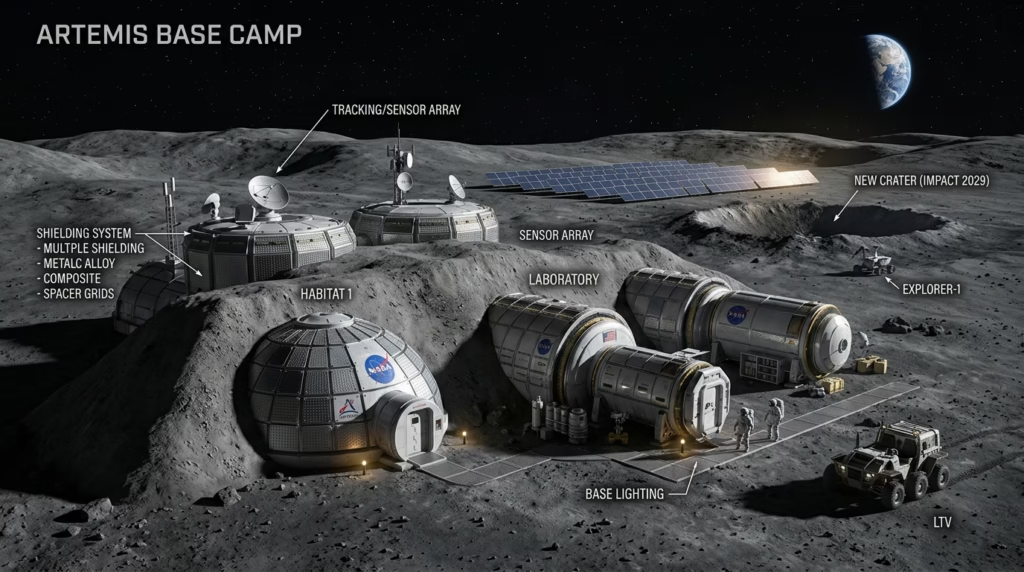
The Artemis program isn’t just about flybys; it’s about “staying.” The discovery of six impacts in such a short window highlights a significant risk for the planned Artemis Base Camp.
The Danger of Hyper-velocity
On Earth, the atmosphere acts as a shield, incinerating most debris. On the Moon, even a pebble-sized object can be lethal.
-
Direct Hits: A meteorite could depressurize a habitat or damage solar panels.
-
Ejecta: The “splash” of soil from an impact (secondary craters) can travel miles and sandblast sensitive equipment.
“The daily flux of meteors should be monitored more closely in the future before a lunar base is established.” — Peter Schultz, Brown University.
Strategic Mitigation
Engineers are now using the Artemis II data to refine shielding requirements. This includes:
-
Whipple Shielding: Multi-layered hulls designed to break up projectiles.
-
Regolith Cover: Burying habitats under several feet of lunar soil to provide a natural “armor.”
-
Early Warning Systems: Deploying a network of sensors to track incoming debris trails.
5. The Human Element in Space Exploration
The “audible screams of delight” from the Houston ground crew emphasize a core truth: machines see, but humans observe. The ability of astronauts like Jeremy Hansen and Reid Wiseman to quickly identify and describe the nuances of these flashes—their color, duration, and frequency—provided context that a standard sensor might categorize as mere “noise.”
Training the Eyes
NASA astronauts undergo rigorous training to identify astronomical phenomena. This preparation allowed the crew to distinguish between:
-
Instrument Glints: Light reflecting off the spacecraft windows.
-
Cosmic Rays: High-energy particles that can cause flashes inside the eye (phosphenes).
-
True Impacts: Light originating specifically from the lunar surface.
6. How We Track Lunar Impacts from Earth
While the Artemis crew had a front-row seat, scientists use several methods to monitor the Moon constantly. Understanding these methods helps students of astronomy appreciate the scale of the Artemis discovery.
Ground-Based Monitoring
Projects like NELIOTA (Near-Earth Object Lunar Impacts and Optical Traces) use large telescopes equipped with high-speed cameras to monitor the dark portion of the Moon. They look for the same “pinpricks” the astronauts saw.
Seismic Sensors
During the Apollo missions, astronauts left behind seismometers. These instruments “felt” the vibrations of the Moon when hit by meteorites. Modern lunar science aims to deploy a new Lunar Geophysical Network to provide a 3D map of how impact energy travels through the Moon’s crust.
7. Educational Summary: The Lifecycle of a Lunar Impact
To understand the Artemis II report, one must understand the sequence of events during a strike:
-
Approach: A fragment of an asteroid or comet enters the Moon’s gravity well.
-
Contact: The object hits the regolith at roughly .
-
Shockwave: A shockwave compresses the rock, turning kinetic energy into heat.
-
The Flash: A brief burst of light is emitted as material is vaporized.
-
Excavation: A crater is formed, usually 10 to 20 times the size of the impactor.
-
Settling: The vapor cools, and the debris (ejecta) falls back to the surface.
8. Conclusion: A New Era of Lunar Science
The Artemis II mission has proven that the Moon is far from a “dead” world. It is a dynamic environment, constantly being reshaped by the surrounding cosmos. The six flashes witnessed by the crew serve as a reminder of the vacuum’s volatility and the necessity of robust engineering as we prepare to return to the lunar surface.
As we look toward Artemis III and the first human landing of the 21st century, the data gathered by Wiseman, Hansen, Glover, and Koch will be instrumental. We are no longer just visiting the Moon; we are learning to live within its rhythmic, albeit sometimes violent, cosmic cycle.
Key Terms to Remember
-
Regolith: The layer of unconsolidated rocky material covering bedrock (lunar “soil”).
-
Hyper-velocity: Speeds exceeding meters per second; the speed at which the strength of materials is small compared to inertial stresses.
-
Flux: The rate of flow of particles or energy over a given area.
-
Plasma: An ionized gas consisting of positive ions and free electrons, created during high-heat impacts.
Reflection Questions for Students
-
How would the lack of an atmosphere on the Moon change the way you design a spacesuit compared to a suit for a high-altitude jet on Earth?
-
Why did the bluish-white color of the flashes indicate a high-temperature event rather than a low-temperature one?
-
If the Artemis crew saw 6 impacts in 7 hours, what does that suggest about the total number of impacts occurring on the entire Moon over a 24-hour period?
for more unique articles || Click HERE