Zepto has kicked off its public-market journey by confidentially filing draft papers with the Securities and Exchange Board of India (SEBI) for an initial public offering (IPO) of about Rs 11,000 crore, aiming for a stock-market debut next year. This move positions the quick-commerce unicorn among the youngest Indian startups to tap public markets, even as it continues to scale aggressively on the back of rapid growth, heavy funding, and a high-burn operating model.
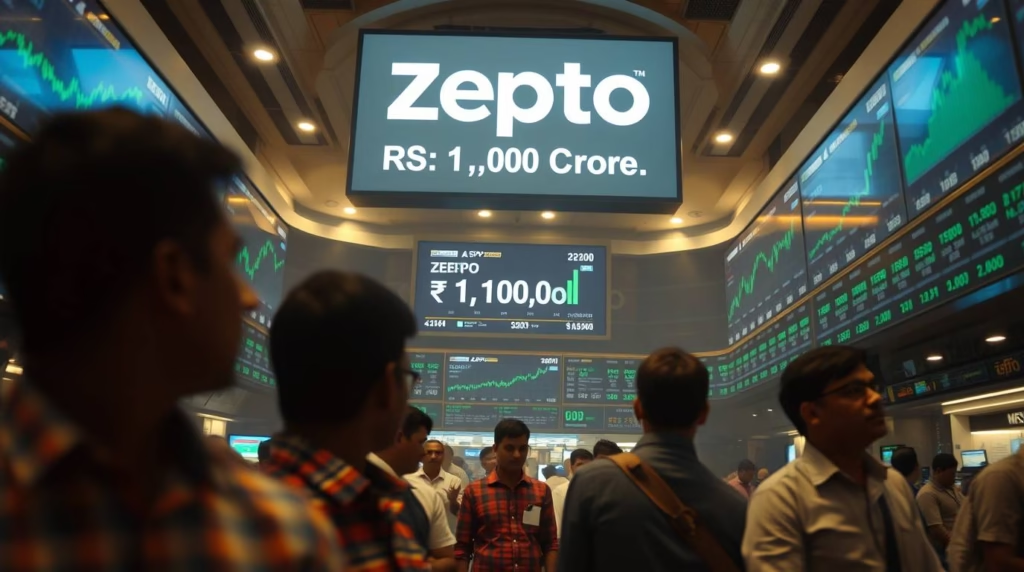
Zepto’s IPO plan
Zepto has submitted a pre-filed draft red herring prospectus (DRHP) to SEBI and Indian stock exchanges under the confidential pre-filing route, seeking to raise roughly Rs 11,000 crore (around USD 1.3 billion). The proposed issue is expected to consist largely of a fresh issue of equity shares, giving the company significant primary capital to invest in expansion, technology, and operational efficiency.
The company is targeting a listing sometime next year, with market reports indicating a likely debut in the 2026 financial year, subject to regulatory approvals and market conditions. If timelines stay on track, this would make Zepto one of the youngest consumer-internet ventures to list on Indian bourses, given that it was founded only in 2021.
Why the confidential route is strategic
By opting for the confidential pre-filing route, Zepto can engage with SEBI for detailed feedback on its offer document without immediately making the draft public. This structure allows the company to tweak its offer size, timing, and key disclosures in response to regulator inputs and changing market sentiment, all while operating away from early media and investor scrutiny.
The confidential route has become increasingly popular among high-growth technology and consumer-internet startups planning large IPOs, especially after the volatile post-listing performance of several new-age companies in recent years. For issuers, it creates a more risk-managed path to the public markets, reducing reputational damage if plans are delayed or shelved and preserving optionality to pause the process if macro conditions turn adverse.
Position in India’s quick-commerce landscape
Once listed, Zepto will stand alongside listed quick-commerce players such as Zomato (which owns Blinkit) and Swiggy (through its Instamart vertical), both of which are already present on Indian stock exchanges. Zomato’s parent company went public in 2021, while Swiggy completed its long-awaited IPO in November 2024, setting important benchmarks for revenue growth, profitability pathways, and public-market expectations in the food and grocery delivery space.
Zepto’s public-market debut is therefore not just a standalone event, but part of a broader evolution of India’s digital commerce ecosystem where investors can track and compare multiple listed players in adjacent categories like food delivery, grocery quick-commerce, and hyperlocal logistics. In that sense, Zepto’s IPO will likely be scrutinized for its growth metrics, margins, and cash burn relative to these already-listed peers, making competitive positioning a central narrative in its IPO marketing.
Backing, valuation, and funding history
Zepto is stepping into the IPO lane after securing substantial backing from global and domestic investors, giving it a strong equity cushion before tapping public capital. The company has raised about USD 1.8 billion (roughly Rs 16,000 crore) since inception and currently commands a valuation of around USD 7 billion.
In October 2025, Zepto closed a major funding round of approximately USD 450 million led by the California Public Employees’ Retirement System (CalPERS), which marked a step-up from its prior valuation and has been widely seen as a pre-IPO round. This capital infusion came about a year after a previous raise in November 2024, when the firm secured USD 350 million at a valuation of around USD 5 billion, underscoring strong investor confidence in its growth trajectory.
Growth metrics and operating scale
Founded in July 2021 by Stanford dropouts Aadit Palicha and Kaivalya Vohra, Zepto has rapidly built a national footprint around its 10-minute grocery and essentials delivery model. The company operates on a dark-store network strategy, using small, tech-enabled warehouses located close to dense residential and commercial clusters to ensure hyper-fast delivery timelines.
As of September 2025, Zepto was running more than 900 dark stores across multiple Indian cities, generating gross sales of about USD 3 billion, or roughly Rs 26,000 crore. The company has also publicly highlighted strong order-volume momentum, with quarterly order growth estimated at around 20–25 percent, even as it seeks to narrow losses and improve capital efficiency.
Cash burn and path to efficiency
Despite impressive scale, Zepto remains in a heavy investment phase with a sizable cash burn as it pushes for market share and customer loyalty in quick commerce. As of September 2025, the company was burning between Rs 1,000 crore and Rs 1,100 crore in cash, reflecting ongoing spends on dark-store expansion, logistics, discounts, and technology infrastructure.
Management, however, has indicated that burn is trending down relative to revenue growth, with internal metrics suggesting improving unit economics and better capital efficiency. The company has also disclosed that it holds close to USD 900 million in net cash, giving it a runway to keep investing even before the IPO proceeds arrive and signalling to prospective investors that liquidity risk is relatively contained.

The broader shift to risk-managed listings
Zepto’s decision to use the confidential pre-filing route reflects a broader shift in how consumer-tech and internet startups approach public listings in India. After a wave of high-profile IPOs where stock prices saw sharp corrections post listing, founders and investors have become more cautious about valuations, timing, and narrative management in public markets.
Under this newer, more measured approach, startups aim to enter markets with more robust balance sheets, clearer paths to profitability, and the ability to recalibrate plans if investor appetite softens. Zepto’s pre-IPO funding at a USD 7-billion valuation, significant cash reserves, and confidential DRHP structure all signal an attempt to balance high growth with disciplined risk management ahead of its planned public debut.
What the IPO could mean for investors
For public-market investors, Zepto’s IPO offers exposure to India’s fast-growing quick-commerce segment, which sits at the intersection of e-commerce, grocery, and hyperlocal logistics. The company’s aggressive growth, large addressable market, and technology-driven operations may appeal to investors looking for high-growth consumer-tech stories with multi-year expansion potential.
At the same time, factors such as continuing cash burn, intense price competition, and execution risk around profitability timelines will likely influence valuations and investor appetite. How Zepto positions itself against listed peers in terms of unit economics, customer retention, and margin improvement will be critical in determining market reception once the IPO opens for subscription.
more articles. visit BB