Moon’s South Pole Secrets: A 4-Billion-Year-Old Mystery
Imagine astronauts from NASA’s upcoming Artemis missions stepping onto the Moon’s south pole, boots crunching into regolith that holds whispers from 4 billion years ago. This isn’t science fiction—it’s grounded in cutting-edge research revealing the lunar surface as a treasure trove of cosmic history. A groundbreaking study spotlights the South Pole-Aitken (SPA) basin, the solar system’s largest impact crater, offering profound clues about the Moon’s violent birth and its quirky asymmetry. Led by planetary scientist Jeffrey Andrews-Hanna at the University of Arizona, this work, published in Nature, reshapes our understanding of lunar evolution and primes the area for Artemis explorers.
Why does this matter for space enthusiasts and scientists alike? The Moon’s south pole isn’t just a landing spot; it’s a geological time capsule. As Artemis missions gear up to touch down there in the coming years, they’ll access the richest scientific site on the lunar surface—one that could unlock secrets about our own planet’s origins.
The Colossal Collision That Scarred the Moon
Picture a cataclysmic event 4.3 billion years ago: a massive asteroid, hurtling through space, grazes the Moon’s far side with devastating force. This glancing blow excavates the South Pole-Aitken basin, stretching over 1,200 miles north-south and 1,000 miles east-west. Far larger than any Earth crater, the SPA basin dwarfs even the Vredefort crater in South Africa, making it a standout feature in lunar geography.
Andrews-Hanna’s team didn’t just measure its size—they dissected its shape. By comparing the SPA to other giant basins like Hellas on Mars and Utopia on the same planet, they uncovered a telltale “teardrop” profile. The basin narrows precisely in the direction the impactor traveled, defying older models that pegged the strike as coming from the south. Instead, data points north, suggesting the asteroid skimmed in from that direction before ricocheting away.
This revelation has huge implications for NASA Artemis missions. “Artemis will land on the down-range rim of the basin,” Andrews-Hanna explained in a University of Arizona release. That’s prime real estate—where ejecta from the Moon’s deep interior piled up. Future explorers could scoop up pristine samples from the solar system’s oldest and grandest impact site, revolutionizing our grasp of ancient moon impacts.
Probing Secrets Beneath the Lunar Surface
To crack this puzzle, researchers dove deep into lunar data from NASA’s Lunar Reconnaissance Orbiter and Gravity Recovery and Interior Laboratory (GRAIL) missions. They mapped the crater’s topography, crustal thickness variations, and chemical signatures with unprecedented precision. The evidence? A northward trajectory aligns perfectly with thinner crust and anomalous compositions in the basin’s floor.
These findings ripple outward to the Moon’s formative years. Scientists long theorized a global magma ocean blanketed the young Moon after its fiery origin—likely from a Mars-sized body smashing into proto-Earth, flinging debris that coalesced into our satellite. As this ocean cooled over eons, denser minerals plunged to form the mantle, while buoyant ones rose to craft the crust.
But the finale was dramatic: a final slurry of molten material lingered between layers, enriching it with potassium (K), rare earth elements (REE), and phosphorus (P)—dubbed KREEP. Andrews-Hanna likens it to a freezer mishap: “Leave soda in too long, and the watery part freezes first, concentrating sugary syrup in the last liquid pockets.” On the Moon, KREEP resisted solidification, pooling in incompatible riches that trace the planet’s internal churn.
This process wasn’t uniform. GRAIL data shows the Moon’s far-side crust averages 30 miles thick, versus a thinner 20 miles on the near side. Such disparities fueled uneven cooling, with KREEP terrains clustering where the crust was thinnest.
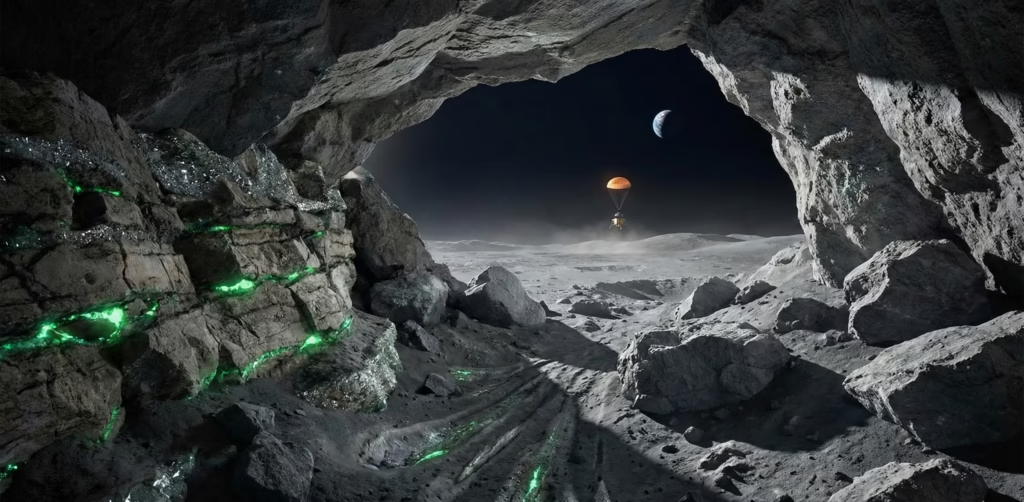

Why the Moon’s Two Faces Tell Different Stories
Stare at the Moon from Earth, and you’ll see its near side: a patchwork of dark “maria” (basaltic seas) from ancient volcanism. Flip to the far side, and it’s a battered highland of craters and highlands. This stark dichotomy—the Moon’s famous asymmetry—has puzzled astronomers for decades. Why the lopsided lava flows?
Andrews-Hanna’s model pins it on crustal thickness. The far side’s beefier shell resisted penetration, forcing magma ocean remnants to ooze toward the near side “like toothpaste from a squeezed tube.” This migration concentrated KREEP there, sparking prolific volcanism that painted the Earth-facing visage.
Enter the SPA basin as a smoking gun. Orbiters detected thorium hotspots—radioactive KREEP proxies—skewed to one basin flank. This isn’t random; it exposes a “window” through the crust, where ancient flows once surged. Such anomalies highlight how one mega-impact could ripple through lunar development, influencing everything from volcanism to magnetic fields.
For SEO-savvy space watchers searching “moon formation history,” this asymmetry ties into bigger questions: Did similar dynamics shape Earth’s early crust? The Moon as Earth’s mirror offers tantalizing parallels.
KREEP and Lunar Evolution: A Deeper Dive
KREEP isn’t just jargon—it’s a geochemical fingerprint. High thorium levels correlate with heat-producing elements, which drove prolonged melting and volcanism. On the near side, KREEP abundance fueled billions of years of eruptions, forming the maria we admire during full moons.
Contrast this with the far side’s sterility: thicker crust trapped heat inefficiently, stifling lava upwellings. The SPA impact, by excavating 5-10 miles of crust, likely excavated mantle material laced with KREEP, scattering it asymmetrically. Modern simulations back this, modeling how oblique hits deform basins into teardrops while excavating deep.
This ties into solar system-wide patterns. Giant basins from Mercury to Mars share the trait, suggesting oblique impacts dominated early bombardment. For lunar scientists, it’s a eureka moment in decoding moon evolution.
Artemis Missions: The Key to Unlocking Lunar Clues
NASA’s Artemis program isn’t chasing flags and footprints—it’s science-driven. Planned landings hug the south pole for water ice in shadowed craters, vital for future bases. But the SPA rim adds a bonus: direct access to impact ejecta.
Orbital scans map thorium, but they’re indirect. “Samples from Artemis will transform that,” Andrews-Hanna notes. Labs worldwide, including Arizona’s, will dissect these rocks for isotopes, minerals, and ages—pinpointing the magma ocean’s endgame. Imagine confirming KREEP’s role in asymmetry or tracing the impactor’s origin.
This could illuminate Earth’s twin history. The giant impact hypothesis posits shared magma oceans; lunar samples might reveal bombardment timelines affecting both worlds’ habitability.
Broader impacts? Artemis paves the way for commercial lunar economy—helium-3 mining, observatories, even Mars staging. SEO trends like “NASA Artemis south pole” spike as missions near, underscoring public hunger for these revelations.
Looking Ahead: What Moon Samples Will Reveal
As 2026’s Artemis III eyes the south pole, expect headlines. Will samples prove the northward impact? Expose new KREEP layers? Decode the asymmetry’s full story? They might even hint at lost magnetic dynamos or water origins.
For now, Andrews-Hanna’s study cements the SPA as lunar ground zero. It bridges orbital data to boots-on-ground reality, promising answers to “How did the Moon—and Earth—become?”
In a universe of mysteries, the Moon’s south pole stands as our nearest, most accessible archive. Artemis won’t just visit; it’ll rewrite cosmic textbooks.
for more facts visit BB